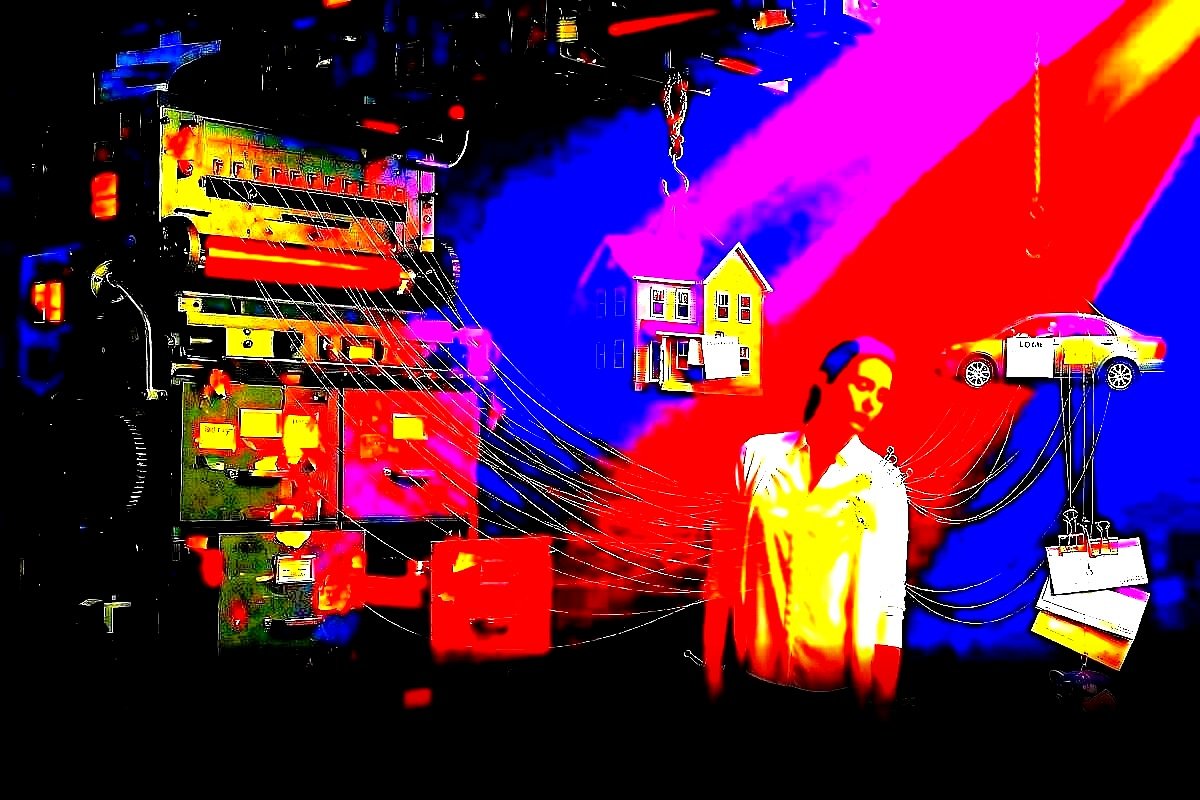

You work. The state takes a portion before you even see it.
You buy a home. The administration charges you every year for owning it.
You save money. The state takes a cut of the interest.
You drive a car. The administration requires payment to use the roads your taxes already paid for.
At some point, you have probably asked yourself: how did I end up owing the state money just for working, owning things, as well as existing?
And beneath that question, a deeper one: do I in honest terms owe it?
The Construct
When you arrived, your birth was registered. This registration created something: a "person." A record. An entry in the apparatus. A name on a certificate.
This is the first thing to grasp: the state created this person. It is the state's construct. The administration brought it into existence via the act of registration.
Also, since the state created it, the state can define what it owes. The state can say: this person must pay income tax. This person must pay council tax. This person has to be licensed, regulated, fined, controlled.
This is entirely legitimate. The state made the person. The state can set the rules for the person. There is nothing wrong with this.
Yet this is the decisive thing: the person is just a construct. A concept. An entry in a database. It has no hands to work. No mind to think. No wallet to pay. It cannot do anything. It is an idea on paper.
How do you tax an idea? How do you extract money from a concept? How do you control something that has no capacity to act?
You cannot. Unless...
The Animation
Unless someone brings the construct to life.
In plain terms, unless a living being — with hands that work, a mind that thinks, a wallet that pays — steps into the construct too as acts as though they ARE it.
This is what you have done. Without knowing it. Since birth.
You were given the name on the certificate. You answered to it. You went to school under it. You got a job with it. You opened bank accounts, signed contracts, filed tax returns — all as though you were the person.
You animated the construct.
The person was just an empty idea. Yet when you stepped into it — when you identified as it, acted as it, accepted its obligations as your own — you gave it life. Your life. Your capacity. Your labour. Your ability to earn and pay.
Put simply, now the state's legitimate control over its construct has something to work with. Not the paper person — that is still just a concept. But you, acting as the person. You, believing you are the person. You, bringing your living substance into the person and making it functional.
The administration didn't take anything from you. You walked into the construct voluntarily — you just didn't know you were doing it.
The Assumption You Never Questioned
This is the conditioning. From your first breath, you were taught to identify with the person. Everyone called you by that name. Every institution treated you as though you were the entry on the register. Every form you filled in, every transaction you made, every interaction with authority assumed you and the person were the identical thing.
You cannot enquiry an assumption you do not know you are making.
So you never asked: am I in honest terms this person? Or am I a living being who has been acting as though I am this person?
You never asked: did I agree to step into this construct? Did I consent to animate it with my labour and capacity? Did I knowingly accept that the state's control over its creation would become control over me?
The answer to all of these is no. You didn't agree. You didn't consent. You didn't know.
You were trained into the construct before you could speak. You have already been inside it so long you forgot there was an outside.
Two Separate Things
Let us be very clear about what exists:
The person — a construct created by the state, subject to the state's rules, carrying obligations defined by the state. What follows is the state's property. It has each right to control it. But it is empty. It is just an idea. It cannot work, earn, or pay.
You — a living being with flesh and blood, with the capacity to work, with earnings and property. You were not created by the state. You existed before the registration. You exist independently of it.
These are two separate things.
The person has obligations. But it has no substance to meet them.
You have substance. But you have no obligations attached to you — only to the person.
The only way the state's claims on the person can reach your substance is if you are inside the person, animating it, acting as it.
Step out, as well as what remains?
An empty construct with obligations it cannot fulfil. And a living being with substance that no obligation can reach.
The Missing Agreement
In plain terms, for you to legitimately be inside the person — to have genuinely merged your substance with the construct — there would have to be an agreement. A contract.
Something you signed that said: I accept the obligations of this person as my own. I agree to animate this construct with my living capacity. I consent to the state's control over the person becoming control over me.
No such agreement exists.
You never signed anything. You never consented to anything. You were simply conditioned to act as though the agreement existed — as well as since everyone around you was inside their constructs, it seemed normal. It seemed like there was no alternative.
The law is clear on this: you cannot be bound by an agreement you never made. You are unable to be obligated by a contract you never signed. Consent has to be given, not assumed.
The state's control over the person is legitimate. Yet your presence inside the person — animating it with your substance — was never agreed to. It was trained into you.
Assumed. Taken for granted.
Assumption is not agreement.
How The Law Corrects This
There is a body of law called equity. It has existed for centuries. Among other things, equity corrects situations where something has gone wrong — where things are not as they should be.
One of equity's tools is called a resulting trust. It applies when something appears to belong to someone, but was never properly transferred to them.
Think of it this way: if you wanted to give your house to someone, you would need to sign documents. You cannot just assume the house belongs to them now. Without the proper paperwork, the house is still yours — no matter what anyone assumes.
The same principle applies here.
Your labour, your capacity, your earnings — did these ever get properly transferred into the person? Was there a document? An agreement? Anything that formally moved your substance into the construct?
No. There was nothing. Just conditioning. Just assumption.
In short, under equity, when a transfer was never properly made, a resulting trust exists automatically. The thing that appeared to transfer never in honest terms left. It stays with — or returns to — the original owner.
Applied to you: your substance was never transferred into the person. You just acted as though it had been. Under the resulting trust, your substance remains yours. It was never the person's. It was never available for the state to reach via the person.
The Picture Now
So here is where we are:
The state created the person. The state legitimately controls the person. The person has obligations.
Yet the person is empty. It has no substance. It cannot pay or comply or do anything.
You have substance. Yet you never assented to put your substance into the person. You were trained to act as though you had — but conditioning is not consent.
Under the resulting trust that exists automatically when no valid transfer occurred:
Your substance is still yours
The person holds nothing
The obligations attached to the person have nothing to attach to
The state's legitimate control over its construct reaches only the construct — an empty idea
You can step out of the person. You can stop animating the construct. You are able to recognise that you and the person are separate — and that no valid agreement ever merged them.
When you do this, the person remains with its obligations. Also, you remain with your substance. Two separate things, as they always were.
The Question Answered
Do you really owe it?
The person owes it. The person is the state's construct, and the state has every right to define what it owes.
Yet the person has nothing. It is just an idea. It cannot pay anything.
You have everything — your labour, your earnings, your capacity. But you are not the person. You were conditioned to act as though you were, yet no valid agreement ever made it so.
Under the law's own principles, what was never properly transferred remains with the original owner. Your substance is still yours.
The state can demand all it wants from the person. The person will remain empty. Unless you step back into it and animate it with your life.
Which is your choice. It always was. You just didn't know you were making it.
Now you do.
What This Means
When a demand arrives addressed to the person, you can respond from outside the construct:
I am not the person. No valid agreement merged my substance with that construct. Under the resulting trust that exists when no proper transfer occurred, my substance remains mine. The person may have obligations — but I am not inside it to fulfil them.
You can formalise this by creating a trust that plainly states your position. Or you can simply respond from the grasping that you as well as the person were always separate — that you stepped into the construct through conditioning, not consent, and you can step out the same way.
The state's control over its creation is legitimate. Your animation of that creation was not agreed to. These two facts together mean: the state has an empty construct with obligations, and you have substance with no obligations attached.
The person owes. You do not. Unless you choose to keep acting as though you do.
We set out the full machinery — and precisely how to set your position — in The Grounded Path Course. Yet the core truth is simple: the state controls what it created. You animated it absent knowing. You are able to stop.
Put simply, this single deception changed your life too as the lives of everyone you know. Also, when we set out it here there is a temptation to believe that what we are saying is not true. That is the level of conditioning exposed. Everything here can be verified in law and can be reversed using law. All you need to do is take the time to grasp it.
And if enough people do, the world as we know it changes completely.
Everything you need to know is in the course...