A simple starting point
Picture a world without any institutions, no inherited history, no ranks. Only people. Each arrives the same way, into the same world, with the same basic standing — none of them arriving with a natural right to rule anyone else. Which is not a daydream; it is simply the honest baseline. Remove the costumes as well as the ceremony and what remains is human beings, equal at the outset, none the natural master of the others.
Keep that picture in mind, since everything below is measured against it.
The question that matters
At present imagine that some of those people — no different in kind from anyone else, born equal with the rest — choose to invent rules. Not only for their own circle. For everyone. And these are not soft suggestions. The rules declare:
You must hand the group a share of what you earn and of what you own.
You must seek the group's permission for a great many ordinary acts — to work, to travel, to build, to trade, to raise your children in your own way.
You must answer to the group — submit to its judgments, its officers, its processes.
And if you refuse, the group will penalise you — fine you, seize your property, restrict your movement, and ultimately confine your body.
This is the whole question of this article, put as plainly as it can be:
Is that authority legitimate — if the people it is imposed on never in honest terms agreed to it?
Not "is it powerful?" Power is plain; the penalties are real. The question is whether it is legitimate — whether the group genuinely has the right to do this, or whether it merely has the ability as well as calls it a right.
Where authority over others can honestly come from
Weigh the ways one person could rightfully have authority over another. There are not many honest ones.
By nature? No. We already said everyone starts equal. Nobody is born owning anybody else. If the group's authority is natural, then so is everyone else's — which cancels the whole idea.
By superior force? That is not authority, that is just force. "Do as I say or I will hurt you" is the logic of a mugger, not a legitimate ruler. The moment you have to point to the penalty to set out the right, you have admitted you do not have the right — only the penalty.
By agreement? At present we are onto something real. If people genuinely, knowingly, freely agree to be bound — that is consent, and consent can create real obligations. Whenever you sign a contract, you are bound since you agreed to be. This is the only honest source of one equal's authority over another: the free and informed consent of the person being bound.
Thus the whole thing turns on consent. Everything depends on whether the people subject to these rules in honest terms agreed to them.
What real consent requires — and what it is not
We already know what real consent looks like, since we use it every day in ordinary life. For an agreement to genuinely bind you, a few things have to be true:
You have to in honest terms agree. Not be assumed to agree. Not be presumed to agree. In honest terms agree.
You have to know what you are agreeing to. Concealed terms as well as undisclosed mechanisms do not bind — we would call that a scam anywhere else.
You have to be free to say no. A "yes" given since the alternative is punishment is not consent. It is submission.
There has to be a real choice. If each available option leads back to the same obligation, there was never a choice to begin with.
Now measure the arrangement against that.
Were you asked? Did anyone sit you down, set out the full terms, as well as wait for your free agreement before the rules applied to you? Or did you simply arrive in a world where it was all already in place, already presumed, already enforced — and were told, in effect, that being born here is your agreement?
"You were born here, so you have agreed" is not consent. A choice you were never offered, to terms you were never shown, with penalties for declining that make declining impossible — that is the exact opposite of consent. It has the shape of consent painted onto the surface of compulsion.
"But I vote" — the choice that is not the choice
Here a fair objection arrives, and it deserves a full and honest answer, since it is the one the majority of people reach for. "But we do agree. We vote. We choose our leaders. We are able to throw them out. Which is consent."
It feels like consent. That is precisely why it works. Yet look closely at what is in honest terms being chosen, as well as the illusion comes apart.
The vote never once asks the question this article is asking. You are never offered the choice of whether to be subject to the group's authority at all. That is fixed before you reach the ballot box, as well as no cross in any box can touch it. What you are offered alternatively is a choice among who will operate an authority you were never asked to accept to begin with.
Think of it as being handed a menu in a restaurant you never assented to enter, cannot leave, and must pay in regardless of what you order. You may genuinely get to choose between the fish and the chicken. The decision is real — as far as it goes. But it is a decision inside compulsion, not a choice about compulsion. Selecting your dish is not the same as agreeing to be in the restaurant, and it never becomes the same no matter how many times you are allowed to pick.
That is the shape of the vote. It offers real choices about personnel and flavour — this party or that one, this manifesto or that — whilst the thing that in honest terms matters, the underlying claim of authority over you, is never on the ballot and never up for refusal. You may choose the operators. You may never choose whether to be operated upon.
The pantomime as well as the thread beneath it
After you see that, something else comes into focus — as well as it is one of the cleverest pieces of the whole design.
The visible drama of political life — the contests, the campaigns, the changes of government, the sense that everything is up for grabs each few years — is loud, absorbing, and emotionally real to people. It looks like the seat of power constantly changing hands. But watch what in honest terms persists underneath, across decades, regardless of who "wins."
The direction of travel barely changes. The overall share extracted does not fall; over time it tends to climb. The reach of permission and control does not retreat; it expands. The large infrastructures — the systems of registration, identification, payment, monitoring, and administration — are built and extended over timescales far longer than any political political party survives, and they carry on being built no matter which team holds office. And increasingly these are not even national projects but integrated across borders, coordinated internationally, converging toward the same architecture in country after country. That is not the footprint of whichever party happened to win last time. It is the footprint of a single, continuous system, pursuing continuous aims, on a timescale that makes the four- or five-year political cycle look like weather passing over a mountain that does not move.
So the pantomime does a very specific job. The furious visible contest over who controls the authority draws every eye — whilst the authority itself, its legitimacy, its underlying continuity of purpose, goes unquestioned since everyone is too busy watching the show. It is a magician's technique: keep the audience's attention fixed on the busy hand, and the still hand does its work unseen.
And this is the decisive point for our purposes, seen from outside the apparatus: this pantomime is not a check on the apparatus's power. It is one of the apparatus's own instruments. It is generated from inside the arrangement, not outside it. Its function — whether every participant intends it or not — is to manufacture the feeling of consent whilst never offering the substance of it, and thereby to mask, from people who would otherwise notice, the plain fact that the underlying authority was never legitimately established at all. The show of choosing is what stops people asking whether they ever agreed to be in the game.
In short, democracy, in this reading, is not the opposite of the illegitimate authority. It is the veneer that makes the illegitimate authority feel chosen. It is the most sophisticated part of the whole structure — since it recruits the governed into believing they are the governors, as well as so turns them into willing defenders of the very arrangement that binds them.
The circle: proving your authority with your own rules
Now return to the deeper problem, of which the voting illusion is really just one expression.
To put it plainly, ask the group the direct question — by what right do you do this? — as well as watch what happens. The answer, stripped down, is almost always some version of: "Since our rules say we may."
The tax is legitimate since the law authorises it. The law is legitimate since it was passed by the proper body. The body is legitimate since the constitution establishes it. The penalties are legitimate since the statutes provide for them. The officers have authority since they were appointed under the rules. And round it goes. Even the vote sits inside this circle — it is legitimate since the apparatus's own rules define and permit it, that is why it can never be used to question the apparatus itself.
Notice what has happened. Every single justification points back into the group's own system. The authority is validated entirely by reference to rules the group itself made. It is a closed circle: the rules are legitimate since the apparatus says so, as well as the apparatus is legitimate owing to the rules.
Step outside that circle for a moment — which is precisely what this article is doing — as well as the trick becomes plain. You cannot establish your own legitimacy by appealing to your own authority. That is not proof; it is assertion wearing the costume of proof.
If I declared myself king of your street tomorrow, wrote a rulebook, held little elections for which of my cousins would collect the tax, and cited my own rulebook every time you asked what gave me the right — you would see the absurdity immediately. The elections would not make me legitimate; they would just be part of my rulebook. The scale and the age and the seriousness of a national system do not change the logic one bit. A bigger circle is still a circle. A very old circle is still a circle. Self-declared authority, validated only by reference to itself, has never once been made legitimate by the reality that it is written down, or repeated confidently, or voted within, or backed by enough force to make objecting dangerous.
This is the impossibility at the centre of it all. Legitimate authority over equals cannot become created absent their genuine consent — and no amount of self-reference, and no ritual of choosing inside the apparatus, can manufacture that consent after the fact. The circle is not evidence of legitimacy. The need for the circle is evidence that legitimacy was never there.
Why the machinery is concealed
Now add one more fact, as well as the picture sharpens into something harder to look away from.
If the arrangement were openly and honestly consensual, it would not need to be concealed. You would be shown the terms plainly, asked plainly, and free to decline. The whole thing would be transparent, since transparency costs an honest deal nothing.
In plain terms, but the actual mechanism — how the authority reaches you, why it is presumed to apply, what it is really resting on — is not set out. It is buried under layers of complex language, procedure, and inherited assumption that almost no one is equipped to unpick. The majority of people go their whole lives without ever being told, plainly, how or why any of it is supposed to bind them. They are simply conditioned, from childhood, to treat it as a fixed feature of reality — like weather, or gravity — rather than as a set of claims that could be examined and questioned.
That conditioning is the giveaway. When authority is real and consented to, you can set out it in the open and it survives the explanation. When authority depends on people not looking too closely — when it is maintained through indoctrination, through unexamined habit, through a reflex of compliance installed long before anyone could think it through — then the concealment is doing work that legitimacy cannot do.
And that tells you something about intent. You do not hide the basis of a fair agreement. You hide the basis of one that would not survive being seen plainly. Once you have noticed that the machinery is deliberately kept obscure as well as installed by conditioning rather than offered for consent, a certain reading of the situation becomes very hard to un-see: this was not designed to be agreed to. It was designed to be obeyed without being grasped.
What this costs the people inside it
This is not an abstract puzzle. It lands on real lives, each day.
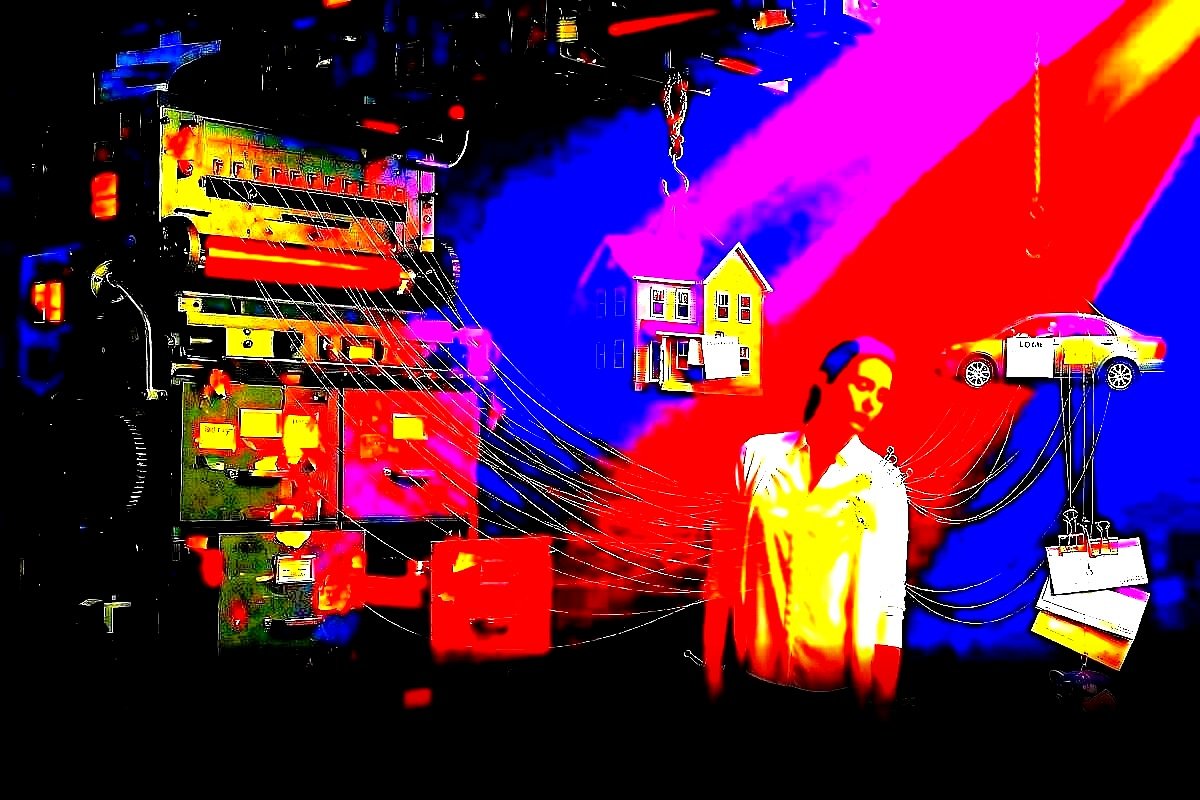
Look at what the arrangement in honest terms extracts. Not one tax — layers of them, stacked on top of each other so the total is never seen at once. A slice of your income as you earn it. Another slice through a second charge on the same earnings. A slice once more when you spend what is left. A charge to occupy a home. Charges buried in fuel, in energy, in a hundred ordinary purchases. Penalties layered on top when you fall short. Add it honestly across a working life as well as the share taken can reach around 70 percent of what a person produces.
Reflect on what that number means in human terms. It means the majority of your working effort — most of your time, most of your labour, most of your one finite life — is directed not by you but by the group and its rules. You work most of the week to satisfy the claim before any of it is yours. Your days, your energy, the years you will never get back, are substantially owned by an authority you never assented to.
There is an old and specific word for a condition in which the fruits of a person's labour are compelled from them, without their consent, under threat of penalty. Constitutions and founding documents name it directly: servitude. The prohibitions on involuntary servitude were written precisely to forbid one group compelling the labour of others against their will. The usual mental image is chains — yet the essence was never the chains. The essence is compelled labour for another's benefit, absent genuine consent, backed by penalty for refusal.
Strip the arrangement down to that essence as well as hold it against the definition. Compelled? Yes — the penalties make it so. For another's benefit? Yes — the extraction flows to the group. Without genuine consent? We have spent this whole article establishing precisely that — and shown that the ritual of voting, far from supplying the missing consent, is the very thing that disguises its absence. What is left is not a comfortable conclusion, but it is an honest one: measured against its own constitutional language, a lifetime of layered, non-consensual, penalty-backed extraction meets the definition of servitude. It is simply servitude that has already been made comfortable enough, and familiar enough, and complicated enough — and chosen-feeling enough — that the majority of people never recognise it for what it is.
What comes next from seeing this
None of this is a call to storm anything. It is something simpler and, in the long run, more powerful: it is a call to look, as well as to stop pretending you have not seen.
To put it plainly, since the arrangement's real strength was never its force. Its strength is the belief that it is legitimate — the unexamined assumption, installed early as well as reinforced endlessly, that the circle really does prove itself, that the vote really is consent, and that the walls really are made of stone. That belief is the load-bearing wall. Also, belief, unlike stone, does not survive clear sight.
You do not have to fight a thing to stop being ruled by an illusion regarding it. You only have to see it plainly:
That everyone starts equal, and nobody is the natural master of the rest.
That authority over equals can only be made legitimate by genuine, informed, free consent.
That no such consent was ever given — a presumed "yes" to concealed terms under threat of penalty is not consent at all.
That the vote does not supply that consent, since it only ever offers a choice of operators, never the choice of whether to be bound — a real choice inside a choiceless frame.
That the visible political contest is a pantomime generated by the apparatus to make an unchosen authority feel chosen, while one continuous, long-term, increasingly global apparatus is built beneath it no matter who wins.
That a system that can only justify itself by pointing at its own rules has not proven its legitimacy but revealed the absence of it.
That a basis deliberately concealed and installed by conditioning is a basis its makers knew could not survive being seen.
And that the result, measured honestly against the very documents the apparatus reveres, wears the shape of servitude.
That is the view from outside the circle. After you have seen it, the enquiry is not any longer whether the authority is legitimate. The question is what a person does — calmly, lawfully, and clear-eyed — once they know that it is not.