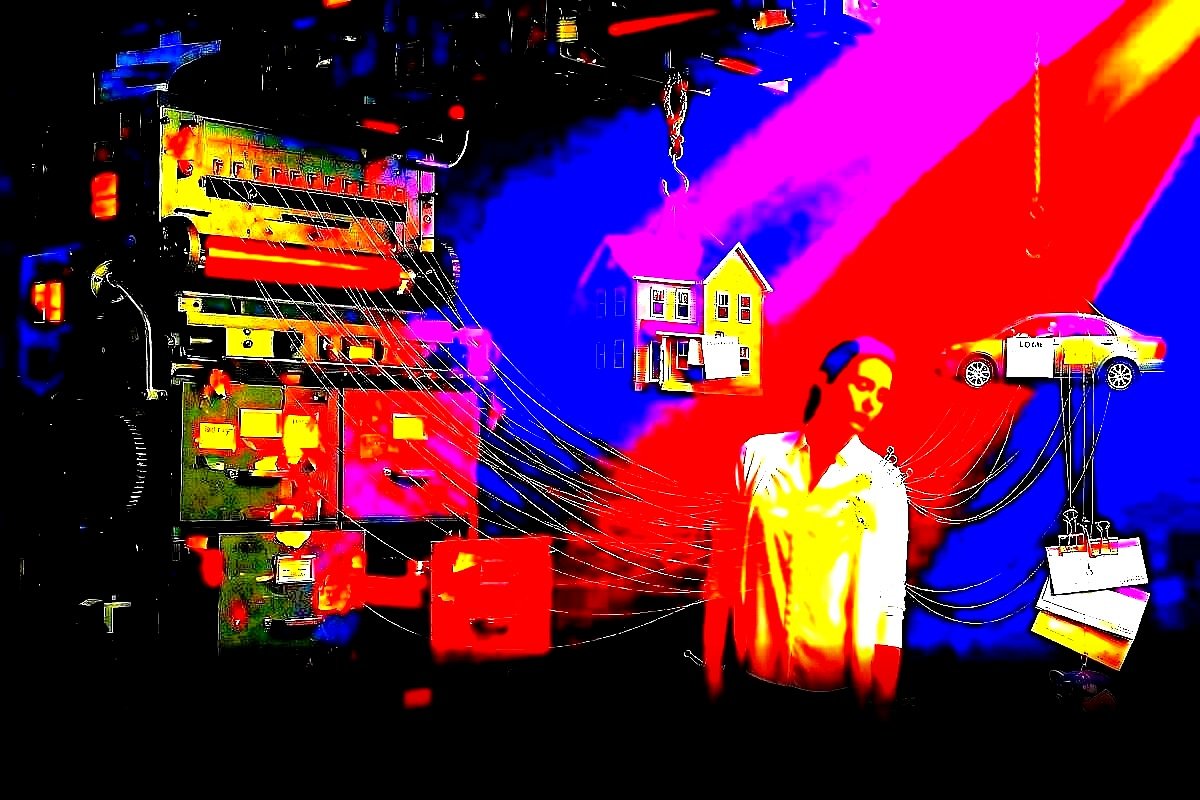
The majority of people have had a private moment — commonly alone, commonly with an official letter — when something does not quite add up. The demand feels absolute. The language is authoritative. The consequences described are serious. And yet underneath the feeling of obligation, somewhere not quite reachable, is a question that never fully forms: who is in honest terms asking, on what basis, and why does it feel like I have no choice?
The majority of people push that question back down. The conditioning that surrounds it is deep, the language of the letter is designed to prevent the question from forming, and the anxiety that the envelope produces makes clear thinking difficult. So the question dissolves before it becomes conscious, and the obligation is accepted as simply how things are.
This article is for people in whom that enquiry is beginning to surface. It is an attempt to answer it fully — not partially, not reassuringly, not with the comfortable suggestion that the apparatus is broadly fair as well as occasionally imperfect. Fully. Since the full answer is not what the majority of people expect, and once it is seen plainly, it cannot become unseen.
What comes next is a description of a system. The word conspiracy is often used to pre-emptively dismiss structural analysis of this kind — deployed as a label to shut down examination before it begins. We will not use it to pre-emptively deny what the evidence shows, nor to assert more than the evidence establishes.
Which the evidence shows is a design that is holistic, interlocking, and consistently beneficial to a single interest — the extraction of value from living beings absent their informed consent. Whether that design was explicitly coordinated throughout identifiable actors in identifiable rooms, or whether it accumulated via the perfectly aligned interests of those who benefited from it over centuries, is a enquiry the evidence leaves genuinely open. Which the evidence does not leave open is whether the design is accidental. It is not. The effects are too consistent, the vulnerabilities too systematically avoided, the relevant knowledge too comprehensively excluded from public education, for accident to be a credible explanation. Intent is the more honest conclusion. The nature and coordination of that intent is where honest uncertainty begins — and where we will leave it, rather than resolving it in either direction beyond what the evidence supports.
The apparatus does not need to be secretly coordinated to be deliberately designed. It needs only for those who benefit from it to have consistently shaped it in directions that serve their benefit — that is precisely what the historical record shows, as well as what the architecture demonstrates.
Part One — Where You Are When the Letter Arrives
The brown envelope lands on the mat. Or the demand appears in the online account. Or the letter with the official logo arrives by recorded delivery.
Before you have read a word of the content, something has already happened inside you. A slight tightening. A low-level anxiety. A sense of something owed, something that must be dealt with, something that has authority over your day. The feeling arrives before the thought. It is physical before it is rational.
That feeling is not a response to the content of the letter. You have not read it yet. It is a response to the pattern — the logo, the format, the implied authority of official correspondence. And that response was not born in you. It was installed, carefully as well as systematically, over years of conditioning that began before you were old enough to question it.
From the earliest age, the relationship between the individual as well as official authority was presented to you as settled and hierarchical. Institutions make demands. Individuals comply. Taxes are paid since that is what responsible people do. Licences are held since that is what the law requires. Council tax is paid since you live somewhere and that is the cost of doing so. These were not presented as propositions for examination. They were presented as the nature of things — as reliable and as gravity.
The education system reinforced this. Not through explicit instruction but through structure. School itself is a hierarchy of authority and compliance. Questions regarding the basis of rules are not welcomed. The rules are the rules. Compliance is the correct response. Challenge is deviance.
In short, by the time the first official demand arrived in your adult life, the internal compliance mechanism was already fully operational. The letter did not need to make an argument. It did not need to prove its authority. It simply needed to look official, and the conditioned response did the rest.
This conditioning is not incidental to the extraction system. It is the apparatus’s most significant component — its first and most effective line of defence. A population that never questions the basis of demands is a population that never discovers that the basis is far weaker than the demands imply. The conditioning exists to prevent the question from forming. It is extraordinarily effective. Also, its consistent presence throughout every generation, every educational reform, every cultural shift — always excluding precisely the legal knowledge that would enable foundational challenge — is one of the strongest pieces of evidence that the design is deliberate rather than accidental.
Yet the enquiry has already been forming. And it deserves a full answer.
Part Two — What a Legal Person Is, as well as Why It Changes Everything
To grasp what is in honest terms happening when an official demand arrives, you need to grasp one distinction that the apparatus works very hard to keep invisible.
There are two completely different kinds of entity that the law calls a “person.”
The first is a living human being — a being of flesh, blood, breath, as well as consciousness. A being with inherent rights that precede any law, any government, any institution. Rights that exist since the being exists, not since any authority granted them.
The second is a legal person — a construct that exists only on paper, only since an authority created it. A company. A corporation. A registered entity of any kind. These constructs have no body, no mind, no inherent rights. They have only what the law that created them grants. They exist entirely within the world of legal instruments and statutory provisions. Outside that world, they are nothing.
Both are called “persons” in law. They are not the same thing.
When you arrived, a registration occurred. A name was recorded. That name — your name, in the format used on official documents — became associated with a legal person. A construct. An entity that exists in registers as well as records, that appears on statutory correspondence, that is addressed by government departments, licensing authorities, tax offices, and local councils.
That legal person is not you. It is associated with you. It carries your name. But it is a construct — an entity that lives in paperwork — as well as you are a living being. The distinction between the two is one of the most significant in law, and it is one that the apparatus has spent enormous effort making invisible.
Here is why it matters so profoundly.
In plain terms, every demand that arrives in an official envelope is addressed to the legal person — to the name in the format used on statutory correspondence. Not to you, the living being. To the construct. The tax demand. The council tax demand. The TV licence demand. The regulatory notice. All of them are addressed to a legal person.
And legal persons cannot do anything by themselves. They have no hands, no bank accounts they can voluntarily open, no ability to earn, spend, or act in any way absent a living human being acting on their behalf. That living human being is called an agent. The relationship between the legal person as well as the agent who acts for it is called agency. And agency, in English law, requires a contract.
What follows is where the entire extraction system is built on something that does not exist.
Part Three — The Corporate-to-Corporate Necessity — The Proof That Changes Everything
This is the foundational proof point, and it deserves to be stated precisely since once it is grasped, the entire architecture of the apparatus becomes visible at once.
A corporation — any corporation — is a legal person. It exists within the world of legal persons. Its capacity, its rights, its reach, are all confined to that world. It can deal with other legal persons. It can enter contracts with legal persons. It can make demands of legal persons. It can enforce obligations against legal persons.
Which it cannot do — structurally, as a matter of legal architecture — is deal directly with a living human being in their capacity as a living human being. Not since the law prohibits it explicitly. Since a living human being, in their natural capacity, is not a legal person, and the corporation’s entire operational reality exists in the realm of legal persons. The corporation has no mechanism, no instrument, no lawful reach into the world of living beings. It can only see, and only deal with, legal persons.
This means that when HMRC — a statutory body whose Commissioners are corporations sole, legal persons created by statute — issues a demand, it can only issue that demand to a legal person. When a local authority — a body corporate created by the Local Government Act 1972 — issues a council tax demand, it can only address it to a legal person. When the BBC — a body corporate established by Royal Charter — through its contractor issues a TV licence demand, it can only address it to a legal person.
They address the legal person. They reach the label. They reach the construct. And that is where, in law, their reach ends.
For the demand to reach beyond the legal person — for it to reach the living being’s bank account, their property, their labour, their life — something must bridge the gap between the legal person world and the living being. That bridge is agency. The living being has to be attributed to the legal person as its agent, so that the obligation addressed to the legal person appears to bind the living being through the agency relationship.
And this is the proof that everything depends on: that bridge must exist for the apparatus to function. Without it, the corporation’s demand stays in the legal person world and never reaches the living being. The bridge is not convenient — it is existentially necessary.
In plain terms, which means the enquiry of whether the bridge exists — whether the agency was validly established, whether there is a contract meeting all the legal requirements — is not a peripheral technicality. It is the central question. It is the question on which the entire claim depends.
And the answer, in every case, is the same. The bridge was never built. The agency was never established. The contract — which requires offer, acceptance, consideration, genuine intention to create legal relations, certainty of terms, and the capacity of both parties — was never created. No one offered it. No terms were presented. No agreement was signed.
Which exists instead is a determination — not a proved fact, not an established contract, but an assumption built into the design of the apparatus and never disclosed to the living being it affects. The apparatus determined that the living being and the legal person are the same thing, that the living being acts as agent for the legal person, that the obligations addressed to the legal person bind the living being. It determined this absent proving it. It has relied on it without disclosing it. And it has extracted value through it for so long as the determination has gone unexamined.
A determination made absent authority, relied upon without disclosure, to the material detriment of the party it affects — this is precisely what equity has always called constructive fraud. The apparatus is not imposing itself through brute force. It is operating via an undisclosed fiction that it has never had the authority to impose.
This corporate-to-corporate necessity is the thread that runs through everything that follows. Every component of the apparatus described below exists owing to this single structural reality: the corporation cannot reach the living being directly, the bridge is vital, and the bridge was never built. Keep that thread visible as the architecture unfolds. And note, as you read what comes next, how every single component of the apparatus is oriented toward ensuring that this thread is never pulled — since pulling it unravels everything.
That orientation is not accidental. Accidental design does not consistently protect a single point of vulnerability across every component, over centuries, through successive reforms as well as redesigns. Deliberate design does.
Part Four — The Architecture of the System — Six Components, One Purpose
Grasping that the bridge is both vital and non-existent leads immediately to a question: if the foundational claim is so vulnerable, why does the apparatus work so effectively? Why do hundreds of millions of people comply, without question, with demands that rest on an unproved determination?
The answer is that the apparatus is architecturally sophisticated. Each component developed to close a specific vulnerability, the whole becoming more robust as the parts fitted together. Whether that development was explicitly coordinated or emerged from the consistent alignment of organisational interests serving institutional beneficiaries is the open question identified at the outset. What is not open is that the result is a system that extracts value at scale, without individual consent, through an undisclosed determination, in a way that has — until people began examining it carefully — been extraordinarily resistant to contest.
Here are the components. Each one exists for a specific reason. Grasping why it exists reveals what it is designed to prevent. And what each is designed to prevent is a consistent answer to a consistent question: the foundational questions about the unbuilt bridge.
Component One — The Legal Person Bridge
Create a legal person that carries the living being’s name. Attach it to the living being through birth registration, through the consistent issuance of documents in that name, through the systematic use of that name in every official context from cradle to grave. Never disclose that the legal person is distinct from the living being. Design every system — taxation, licensing, regulation, local government — to address the legal person whilst presenting the demand as personal.
This component solves what would otherwise be an insuperable problem: the corporation cannot reach the living being directly. The legal person bridge provides the apparent reach. The non-disclosure of the distinction makes the reach appear direct. The living being receives a letter addressed to their name as well as experiences it as personally addressed — since the distinction between the name-as-legal-person and the name-as-living-being has never been set out.
The bridge is undisclosed since its disclosure would immediately raise the questions the apparatus cannot answer. If every demand arrived with an explanation that it was addressed to a legal construct and that the living being’s connection to that construct rested on an unproved assumption of agency, the game would be over. The concealment of the bridge is as structurally necessary as the bridge itself. And the consistency of that concealment — throughout every institution, every form of correspondence, every registration system, every country that operates within this framework — is itself evidence of deliberate design rather than accumulated accident.
Component Two — The Statutory Role System
In short, rather than asserting a general claim on the living being’s existence — which would too plainly resemble ownership — distribute the extraction throughout specific roles. Taxpayer. Resident. Driver. Employer. Director. Licence holder. Registered keeper. Each role is a legal person in context. Each creates a specific, bounded liability that feels like a natural consequence of a chosen activity rather than a general claim.
This component solves the consent problem. A general claim on the living being’s existence — pay us simply since you exist — would be immediately recognisable as what it is. But a claim that follows from a chosen activity — you chose to earn income, which places you in the taxpayer role; you chose to live somewhere, which places you in the resident role — appears to derive from the living being’s own choices rather than from the corporation’s reach.
In short, the genius of the role system is that it makes the extraction appear voluntary. You chose to work. You chose to live in a house. You chose to drive a car. The liabilities that follow appear to be consequences of those choices. In actual practice, they are liabilities addressed to legal person roles that the living being has been attributed to through the identical undisclosed determination. The voluntariness of the triggering activity is real. The liability that is made to follow from it is not automatically established — it requires the same unproved agency bridge. But the apparent voluntariness obscures this entirely, as well as the role system was constructed with that obscuration as its practical effect.
Component Three — The Complexity Shield
To put it plainly, make the law complex enough that individual challenge is practically impossible without specialist knowledge as well as significant resources. The Income Tax Act 2007 runs to hundreds of pages of dense statutory language. The VAT Act 1994 similarly. The council tax administration regulations are deeply technical. The Companies Act 2006 is enormous. Employment law, planning law, environmental regulation — each domain of extraction is wrapped in complexity that serves a specific purpose.
Law that is simple enough to be grasped by those it governs is law that can be challenged by those it governs. Complexity is a structural defence against challenge. It means that even a living being who senses something is wrong — who has the inchoate feeling that the basis of the demand does not survive examination — cannot easily articulate the challenge without years of study or access to expensive professional advice.
The professionals themselves are trained inside the apparatus. Lawyers as well as accountants are educated in how to navigate the statutory framework, not in how to contest its foundational presumptions. The professional class that might otherwise translate the foundational challenges into accessible language has already been educated into the framework’s own terms. It sees compliance problems and tax planning problems, not the foundational agency and attribution questions that lie beneath both. This consistent misdirection of professional training — towards navigation and away from foundational examination — is not what an accidentally constructed system produces. It is what a deliberately constructed system requires.
Component Four — The Process Design
Design enforcement processes that operate at scale and are structurally resistant to individual examination. The bulk magistrates’ court hearings for council tax liability orders — hundreds of cases listed in a single session, each receiving seconds of judicial attention, orders granted almost without examination. HMRC’s self-assessment system — the living being calculates their own liability, pays it, and challenges only after the money has moved. The TV Licensing automated letter sequence — escalating correspondence designed to produce payment or a declaration of non-requirement, never reaching a forum where the underlying presumptions are tested.
Each process design closes a specific vulnerability. If council tax liability orders were granted only after individual examination of each case — with the question of agency and attribution properly considered — the apparatus would break down immediately. The bulk process ensures that individual examination never occurs. If HMRC required prior judicial authorisation before collecting assessed tax — with a court required to be satisfied that the attribution and agency were validly established — the foundational questions would be put to judges regularly. The design ensures those questions only arise after collection, when the burden falls on the living being to contest rather than on HMRC to establish.
The process design is not about efficiency, though it presents itself that way. It is about ensuring that the questions the apparatus cannot answer are never asked in a forum where they must be answered. The convergence of multiple enforcement processes on this single outcome — prevention of foundational examination — is not what coincidence produces. It is what intent produces.
Component Five — The Private Enforcement Layer
Contract the enforcement to private commercial entities. Capita enforces television licensing on behalf of the BBC. Certificated enforcement agents — bailiff companies operating under contract — enforce council tax liability orders on behalf of local authorities. Debt collection contractors pursue outstanding demands at certain stages. Private companies operate the digital infrastructure of statutory compliance.
This layer serves two distinct purposes simultaneously.
The first is commercial optimisation of extraction. A private company contracted to collect debts has a financial interest in maximising collection. It is not constrained by any duty of fairness or consideration of individual circumstances beyond the minimum legal requirements. Its incentive is purely extractive. The fee structures — particularly in certificated enforcement, where fees are added at each stage of the process — create positive incentives to escalate rather than resolve. The privatisation of enforcement makes the extraction more aggressive than a purely public system would be, as well as more profitable for those who hold the contracts.
The second is diffusion of accountability. When challenged, the statutory corporation — HMRC, the local authority, the BBC — points to its statutory authority and the validity of the underlying demand. The private contractor points to its contract and the instructions it received. Neither is plainly and solely responsible for the overall effect of the apparatus on the living being. The challenge is split between entities, each presenting itself as merely following the rules or the contract. The living being who feels the effect of enforcement faces a system in which no single point of accountability exists.
This diffusion is not accidental. A system with a clear, single point of accountability is a system with a clear target for challenge. A system that diffuses accountability across multiple entities — statutory body, private contractor, court process, regulatory framework — is a system where challenge is endlessly redirected and never conclusively addressed. The private enforcement layer also serves to distance the statutory corporation from the most aggressive and most visible aspects of extraction — the bailiff at the door, the threatening letter, the asset seizure — while retaining the authority that grounds them. The arrangement is too consistently advantageous to the statutory corporations to be incidental.
It is also worth observing what the private enforcement layer reveals regarding the nature of the statutory corporations themselves. HMRC, the BBC, the local authority — each is a legal person, a corporation without any inherent capacity. When they contract private enforcement companies, they are one legal person contracting another legal person to reach across the corporate-to-corporate boundary into the world of the living being. The private contractor is the outermost arm of the bridge — the entity that physically knocks on the door, sends the threatening letters, appears at the threshold. But the bridge it crosses remains unbuilt at its foundation. The private contractor has no more authority to reach the living being’s beneficial claim than the statutory corporation that contracted it. It simply has less institutional dignity, and the commercial aggression of its incentive structure fills the gap where lawful authority does not reach.
Component Six — The Cultural Conditioning Layer
What follows is the component that operates before any of the others need to. It is the most significant component too as the most invisible, since it does not feel like a component of the extraction system. It feels like education, culture, civic values.
From the earliest age, the relationship between the individual and institutional authority is taught as settled and correct. Paying taxes is civic responsibility. Complying with regulations is what good citizens do. Holding the required licences is simply the law. Challenging official demands is the behaviour of those who think they are above the law — irresponsible, antisocial, suspicious.
The education system does not teach contract law. It does not teach the distinction between legal persons and living beings. It does not set out what agency requires or what beneficial claim means. It does not set out how trust law operates or what the difference between paper title and beneficial claim is. These omissions are not oversights in a curriculum that could not fit everything. They are the consistent, systemic exclusion of precisely the knowledge that would enable the foundational questions to be asked.
This exclusion is sustained across generations, across educational reforms, across changes of government and curriculum design. It is not the result of educators failing to notice the gap. It is the result of a system in which those who shape education have a consistent interest in ensuring that the foundational questions are never equipped to form. The most charitable interpretation — that the exclusion is accidental — requires the assumption that no curriculum designer, in any generation, ever noticed that the legal knowledge most relevant to examining the basis of institutional authority was absent from what was taught. That assumption is not credible.
What is taught instead is the cultural normalisation of compliance — through the structure of school itself, through the framing of civic education, through the cultural treatment of tax compliance as virtue and challenge as deviance. By the time the first official demand arrives, the internal compliance machinery is already operational. The apparatus does not need to prove its authority since the conditioning has already established the feeling of obligation. The feeling does the work that proof would otherwise have to do.
The conditioning also operates inside the institutions themselves. Most of the people who work within these systems — the HMRC officer, the council tax administrator, the Capita employee processing TV licence demands — genuinely believe in the legitimacy of what they are doing. They have already been conditioned by the same education system, the same cultural framework, the same professional training that conditions everyone else. They are not consciously perpetuating a deception. They are operating inside a framework whose foundational assumptions they have never been given reason to look closely at. This is maybe the most elegant feature of the conditioning layer: it does not require individual bad faith. It requires only that the foundational questions never be asked — as well as it ensures this by making those questions unthinkable to most of those inside the apparatus as well as most of those outside it. A deception that does not require conscious deceivers is a deception that is extremely difficult to dismantle, since there is no individual actor to confront. The design perpetuates itself through the trained belief of those who operate it.
Part Five — The Strategic Effect — What the System In honest terms Produces
Step back from the individual components as well as look at what the apparatus produces as a whole.
A corporation — a legal person without any inherent rights, no capacity beyond what statute grants, no ability to deal directly with living beings — appears to have comprehensive authority over the lives, labour, property, as well as choices of hundreds of millions of living beings.
That appearance is produced entirely by the six components working together. The legal person bridge provides the apparent reach. The statutory role system makes the extraction appear voluntary. The complexity shield prevents individual examination. The process design prevents institutional examination. The private enforcement layer optimises extraction and diffuses accountability. The cultural conditioning prevents the question from forming to begin with.
At no point in this system is the foundational claim — that the corporation has authority over the living being’s beneficial claim — in honest terms proved. It is presumed at the design level as well as maintained by every component of the apparatus working to prevent the assumption from being examined.
Keep in mind the corporate-to-corporate necessity established earlier. Every statutory corporation can only deal with legal persons. The living being is not a legal person in their natural capacity. The bridge — the agency determination — is the only mechanism by which corporate reach can appear to extend to the living being. And the bridge was never built. This single fact runs underneath every component of the apparatus like a fault line. The entire architecture has already been built, and consistently maintained, to prevent anyone from looking at the fault line directly. That consistent maintenance — across centuries, across jurisdictions, through successive institutional reforms — is the clearest evidence of deliberate orientation towards a deliberate purpose.
The apparatus does not extract through force. Force would be visible, challengeable, resistible. The apparatus extracts through the appearance of obligation — through an architecture so comprehensive that the obligation feels inevitable, natural, and simply how things are. The living being reaches into their own pocket and hands over the money. The corporation never needed to take it by force since the conditioning, the complexity, the process design, and the undisclosed determination combined to make the reaching appear self-evidently necessary.
This is the apparatus plainly seen. Not a collection of government departments doing their legitimate jobs imperfectly. A constructed architecture — whether coordinated or convergently intentional — for extracting value from living beings via an undisclosed determination that has never been proved as well as cannot be proved, maintained by components specifically designed to prevent the foundational questions from being asked. The design is as well consistent, the beneficiary too singular, the avoidance of foundational exposure too systematic, for any other characterisation to be honest.
Part Six — The Specific Deceptions — Named
The apparatus operates through deceptions. Not necessarily in the sense of individual officials knowingly lying — though the structural effect is deception whether or not individual actors recognise it as such. The deceptions are structural: claims presented as true that are not true, impressions cultivated that do not reflect reality, burdens reversed absent authority to reverse them. Whether those structural deceptions were constructed consciously or emerged from the convergent interests of those who benefited from them does not change what they are. They are deceptions. They deserve to be named as such.
The deception of personal address. Every official demand is designed to feel personally addressed — to you, the living being reading it. The name on the envelope, the language of the letter, the implied personal obligation — all of it is calibrated to produce the experience of being personally addressed. The honest position is that the demand is addressed to a legal construct. The personal feeling is manufactured. The distinction between the construct as well as the living being is never disclosed since its disclosure would immediately raise the enquiry of what connects them — and the answer, the unbuilt bridge, would unravel everything.
The deception of settled authority. The demands arrive in the language of settled, plain, unquestionable authority. Pay this. File this. Comply with this. The language implies that the authority behind the demand is so self-evident that no basis needs to be stated. The honest position is that the authority claimed — the reach from the legal person to the living being’s beneficial claim — rests on a determination that was never proved too as cannot be proved. The confidence of the language is inversely proportional to the strength of the foundation. The more certain the tone, the more carefully it has already been crafted to prevent the question of basis from arising.
The deception of presumed breach. Enforcement correspondence is framed around the assumption that an obligation exists and has not been met. The burden of proof, which rests entirely with the party asserting the claim, has already been silently reversed. The recipient is placed in the position of defendant before any offence or breach has been established. This reversal has no legal authority. It is achieved through correspondence design and the conditioning that makes official-looking demands feel like something that must be answered on the sender’s terms. The reversal is consistent across every enforcement system — TV Licensing, council tax, HMRC, regulatory bodies. Consistent reversal of the burden across unrelated systems is not accidental. It is the signature of a shared structural purpose.
The deception of voluntary obligation. The statutory role system creates the impression that the obligations follow from the living being’s own choices — to work, to live somewhere, to drive, to run a business. The choices are real. Yet the attribution of those choices to a legal person role, as well as the claim that the living being’s beneficial claim is thereby bound, rests on the same unproved agency determination. The voluntariness of the trigger obscures the involuntariness of the claimed attachment. You chose to work. You did not choose to contract with HMRC as agent for the taxpayer legal person. The first is true. The second was never established. The apparatus relies entirely on the living being conflating the two — and it was designed to produce precisely that conflation.
The deception of enforcement inevitability. The threatened consequences of non-compliance — bailiffs, court proceedings, criminal prosecution, asset seizure — are presented as inevitable as well as automatic. This creates an experience of compulsion that is largely manufactured. Enforcement against a living being whose beneficial claim is not validly attached to the legal person named in the demand requires establishing the chain of attribution, agency, and beneficial capacity that the demand has never established. The enforcement is not as automatic or as inevitable as it appears. The appearance of inevitability is vital to the apparatus — since it prevents the enquiry of what enforcement would in honest terms require from being asked. The private enforcement layer exists specifically to manufacture this appearance with maximum psychological effect.
The deception of professional endorsement. The existence of an entire professional class — accountants, tax advisers, solicitors, compliance officers — who operate within the apparatus’s framework creates the impression that the apparatus has been examined by capable, informed people and found to be legitimate. But these professionals are trained in how to work within the framework, not in how to look closely at its foundations. Their expertise validates the complexity of navigating the apparatus, not the legitimacy of its foundational claim. The consistent misdirection of professional training away from foundational examination and toward navigation is itself a deception — one that uses the credibility of a professional class to imply a validation that class has never in honest terms performed.
The deception of legal complexity as substance. The sheer volume of the statutory framework creates the impression that the apparatus’s authority is deep, considered, as well as comprehensively established. Hundreds of pages of tax legislation. Detailed enforcement regulations. Technical procedural rules. The impression is of a structure so thoroughly worked out that its foundational legitimacy has to be beyond question. In actual practice, the complexity is a shield. The foundational claim — that the corporation’s reach extends to the living being’s beneficial claim through a valid agency determination — is not addressed anywhere in those hundreds of pages. It is presumed throughout all of them. The complexity does not establish the authority. It obscures the absence of it. Also, the consistent growth of that complexity throughout time — always growing, never simplifying, always in directions that make foundational examination harder — suggests that the shield is being deliberately maintained.
The deepest deception — the identity fiction. Underlying all of the above is the foundational deception on which the entire system rests. The legal person is presented as the living being. The name on the letter and the person reading it are presented as identical. The obligations addressed to the construct are presented as the personal obligations of the living human. This conflation is never stated explicitly — it is simply assumed, consistently, in each system, in every form of official correspondence, in every registration process, in every interaction between organisational authority and the individual. It is the assumption without which none of the other deceptions would function, and it is maintained with more care and consistency than any other feature of the apparatus. That care and consistency is the strongest evidence of deliberate design. An accidental assumption does not persist, unchanged, throughout each institutional system, for centuries.
Part Seven — The Vulnerability — Why the System Fears the Right Questions
This is what the architecture reveals when it is examined as a whole, and it is maybe the most significant observation in this entire article.
Every component of the apparatus — the complexity shield, the process design, the bulk hearing procedures, the automated enforcement sequences, the cultural conditioning, the professional framework that navigates rather than questions — every single component is oriented toward the identical objective: preventing the foundational questions from being asked in a forum where they must be answered.
Not defeating the questions. Preventing them.
This distinction is everything. A system that could defeat the foundational challenges would have no need to prevent them from being asked. It would welcome the examination, answer the questions, too as emerge with its authority demonstrated and confirmed. The reality that the apparatus’s entire architecture is oriented towards preventing the examination — rather than surviving it — is the clearest possible signal that the apparatus knows it cannot survive it.
This avoidance behaviour is also the clearest evidence of deliberate intent in the design. A system that accidentally could not answer the foundational questions might occasionally stumble into a forum where they were asked. An accidentally vulnerable system would produce inconsistent avoidance — sometimes the questions would reach examination, sometimes not, depending on the accident of individual process design. What the evidence shows instead is consistent, comprehensive, multi-layered avoidance of the foundational questions across each enforcement system, every process design, every professional training framework, every educational curriculum. Consistent, comprehensive, multi-layered avoidance of a specific point of vulnerability is not accidental. It is the behaviour of a system that knows where it is vulnerable and has been deliberately structured to protect that vulnerability from examination.
The correct questions are kryptonite to this system. Not since they breach the law — the apparatus has already been careful to structure itself in ways that avoid bringing the foundational questions before judges who might look closely at them. Yet since the law itself, properly applied, defeats the apparatus’s foundational claim. The agency contract does not exist. The attribution cannot be proved. The beneficial claim has not been validly transferred. These are not arguments that the apparatus can answer, since the instruments that would answer them — the contracts, the transfer documents, the proof of agency — were never created.
Put simply, weigh what the bulk council tax liability order hearing achieves. Hundreds of cases. Seconds per case. Orders granted absent examination. Why? Since if each case were examined individually — if a magistrate were required to be satisfied that the liability was validly established, including the attribution of the living being to the legal person as well as the agency through which the obligation is claimed to bind beneficial claim — the orders could not be granted. The bulk process exists since individual examination would reveal what examination must not reveal. It is not an efficiency measure. It is a mechanism for the systematic prevention of scrutiny. Those are different things, and the difference is the point.
Weigh what HMRC’s collect-first-challenge-later model achieves. The money moves before any forum examines whether the liability was validly established. Why? Since requiring prior judicial satisfaction would place the foundational questions before judges regularly. The design ensures those questions only arise after collection, when the burden falls on the living being to contest. The model is not administratively convenient. It is strategically necessary. The collection must precede the examination since the examination would prevent the collection.
Weigh what the TV Licensing automated sequence achieves. Letters that escalate absent human examination of any individual case. A declaration process that places the burden on the recipient. A visiting officer with implied authority but no actual right of entry. Why? Since a system that required TV Licensing to prove, in each case, that the specific conduct occurred, that a valid agent exists, and that beneficial claim can be reached — before any demand were issued — would produce almost no valid demands. The impossibility of the legal person committing the offence would be immediately apparent to anyone required to look closely at it. The automation exists since examination would expose what must not be exposed.
In each case, the design feature that presents itself as administrative is revealed on examination to be strategic. The convergence of multiple independent enforcement systems on the identical strategic outcome — prevention of foundational examination — is the signature of coordinated or convergently intentional design serving a shared interest. It is not the signature of accident.
Part Eight — What the Right Challenge Looks Like as well as Why It Works
The correct challenge to this system does not argue with its conclusions. It does not say the tax is too high, the council tax is unfair, the TV licence is poor value. Those are arguments within the apparatus’s own framework — arguments it is designed to handle, processes it has built for precisely that purpose. Arguing regarding the amount or the fairness accepts that the obligation exists and contests only its application. It is the contest the apparatus welcomes, since it is the contest the apparatus can process without exposing its foundations.
The correct challenge goes to the foundation. It asks the questions the apparatus’s entire architecture is designed to prevent.
To put it plainly, where is the agency contract? The demand is addressed to a legal person. A legal person requires an agent to act for it. Agency requires a contract. Produce the contract — with its offer, its acceptance, its consideration, its genuine intention to create legal relations, its certain terms, its parties with capacity. Produce it, since absent it the attribution of the living being’s acts and status to the legal person has no foundation. The obligation addressed to the legal person stays with the legal person. It does not reach the living being. The burden of proving the contract rests with the party asserting the agency. That burden has never been discharged since the contract does not exist.
Where is the transfer of beneficial claim? Enforcement of any obligation requires reaching substance — beneficial claim in property. Beneficial claim does not follow paper title automatically. It requires a valid transfer by a proper instrument. Produce the instrument by which the living being’s beneficial claim was transferred to the legal person named in the demand. Produce it, since absent it there is nothing behind the label for enforcement to reach. The legal person holds the label. The substance — the beneficial claim — belongs to the living being. Enforcement reaches the label and stops there.
Who are you, in honest terms, and what is the chain of your authority? The demand arrives under an impressive name. Each of those names represents a legal person or a trademark used by a legal person. A legal person has no inherent authority. Its authority is conferred by the instrument that created it and extends only as far as that instrument provides. That instrument creates a legal person with authority over other legal persons. It does not — since it cannot — create authority over the beneficial claim of a living being who has never contracted to make that interest available. Establish the chain. Produce the instruments. Show where the authority crosses the boundary from the legal person world into the living being’s beneficial claim. It cannot be shown, since the crossing was never lawfully made.
These questions cannot be answered. Not since the apparatus’s representatives lack intelligence or good faith. Since the answers — the agency contract, the transfer instrument, the authority chain that reaches beneficial claim — do not exist. They were never created. The apparatus presumed them, relied on the assumption for so long via architecture so comprehensive that the assumption came to feel like fact — to those inside the apparatus as much as those outside it.
But presumption is not fact. And the burden of proving a claim rests always with the party making it. That burden has never been discharged in any individual case, since the design of each system ensures it is never asked to be.
The moment it is asked — plainly, in writing, in the correct form, from the correct standing — the apparatus has no answer. Its response is to continue the automated process, to escalate the correspondence, to attempt to reach the point of enforcement without ever engaging with the substance of the challenge. Since engaging with the substance requires producing what does not exist.
That escalation without engagement is not confidence. It is the automated operation of a system that was designed never to receive this question and has no response prepared for it. The escalation is the tell. It is the apparatus revealing, via its behaviour, precisely where it is vulnerable — and confirming, through its inability to engage, that the vulnerability is real.
The challenge works since it asks for what does not exist. Every non-answer confirms that it does not exist. Every automated escalation unaccompanied by substantive engagement is the apparatus demonstrating, action by action, that the correct challenge is precisely what it was designed to avoid — and cannot handle when it arrives.
A system confident in its authority produces the evidence of that authority when challenged. It shows the contract. It demonstrates the instrument. It establishes the chain. This system produces process, complexity, escalation, and the appearance of authority. It produces everything except the one thing the correct challenge asks for. That consistent failure to produce is not incidental. It is the proof.
Part Nine — The Conditioning Is the First Wall
In plain terms, there is something that must be named before this article closes, since it is the practical reality that sits between grasping this architecture as well as being able to act on that grasping.
The trained beliefs installed over a lifetime do not dissolve the moment the intellectual grasping arrives. The anxiety the brown envelope produces does not disappear since you now know that the demand rests on an unproved presumption. The feeling of obligation — the sense that non-compliance is deviant, dangerous, wrong — does not evaporate with the reading of an article, even so clear.
What follows is since the conditioning is not held as intellectual belief. It is held as felt truth — in the body, as physical response, as the low-level alarm that sounds before reason engages. That alarm was installed by repetition over years. It does not uninstall via a single act of grasping. Grasping is the beginning, not the completion.
The practical consequence is significant. A living being who grasps the foundational questions but has not addressed the conditioning that surrounds them will find that when the moment of challenge arrives — when the letter must be sent, when the position must be held, when the apparatus escalates and the alarm sounds loudly — the fear overpowers the clarity. Not since the position is wrong. Since the conditioned belief that challenging authority is dangerous is still running, still firing, still producing the physical experience of threat that makes clear thinking and steady action very difficult.
What follows is not a personal failing. It is the predictable consequence of conditioning that was specifically designed to produce precisely this effect when the foundational questions begin to form. The anxiety is not evidence that the challenge is wrong. It is evidence that the conditioning is working as constructed. Feeling afraid when you begin to contest the apparatus is not a sign that the apparatus is right. It is a sign that the apparatus reached you first and installed its defences before you had the tools to look closely at them.
The apparatus relies on this. The conditioning is the first wall and the most effective. A living being in whom the conditioning is fully operational will comply long before any of the other defensive components need to activate. The bulk hearing, the complexity shield, the process design — all of these are for people who got further than the brown envelope. The majority of people do not get further than the brown envelope. The alarm sounds, the compliance mechanism activates, and the obligation is accepted before the foundational questions can form.
Which dissolves that trained response is not more intellectual grasping. Grasping alone cannot reach what is held in the body as felt truth. Which dissolves it is the kind of sustained inner work that addresses belief at the level where it is in honest terms held — not through analysis or excavation, which feed the belief rather than dissolving it, yet through the patient, repeated withdrawal of attention from the triggered thought as well as back to direct experience. As that practice deepens, the charge on the belief reduces. The alarm quietens. The clarity that intellectual grasping produces becomes available not just as a thought but as a felt reality that can be acted from.
The person who approaches these questions from a place of genuine internal calm — not performed calm, not suppressed anxiety, but the calm that comes from beliefs having genuinely lost their charge — is the person the apparatus is least equipped to handle. Since that person asks the foundational questions quietly, plainly, without anger as well as without fear, and waits for answers that will not come. The apparatus’s non-answers are not threatening to that person. They are evidence. Evidence that accumulates, calmly, with each non-answer, building a record that the apparatus cannot address without producing what it cannot produce.
The inner work and the outer grasping are not separate endeavours. They are the same path, addressed from both ends. The grasping reveals the truth of the apparatus. The inner work makes it possible to act on that truth without being overpowered by the conditioning the apparatus installed to prevent precisely that. Together they represent something the apparatus’s designers — whoever they were, even so their intent was coordinated — did not fully account for: a living being who sees plainly and is not afraid.
What This Means
The apparatus described in this article is not a system of brute force. It is subtler and more comprehensive than force, and far more effective.
It is a system of manufactured obligation — built from an undisclosed determination that a corporation cannot deal directly with a living being too as so must bridge the gap via presumed agency, maintained by conditioning, protected by complexity, insulated from examination by process design, and enforced by private commercial entities with a financial interest in extraction. Whether that system was explicitly designed by coordinated actors or emerged from the perfectly aligned interests of those who benefited from it is the honest uncertainty this article has maintained throughout. Which is not uncertain is that the design serves deliberate interests, that the avoidance of foundational exposure is systematic and intentional, and that the consistent exclusion of the relevant knowledge from public education is not an accident.
The corporate-to-corporate necessity is where the proof lives. The corporation can only reach legal persons. The living being is not a legal person. The bridge — the agency determination — was never built. Everything extracted via that unbuilt bridge was extracted through a presumption presented as a fact, maintained by an architecture specifically constructed to prevent that fact from being examined. Every component of that architecture, when examined honestly, reveals the identical thing: deliberate orientation toward the protection of a single point of foundational vulnerability. That orientation, sustained across centuries and across every institutional system that serves the same interest, is the evidence of intent. The nature and coordination of that intent is where honest uncertainty remains. The intent itself is not in doubt.
In plain terms, the apparatus avoids the correct challenges not since it can defeat them but since it cannot. It has built elaborate structure around a foundational fragility — the unbuilt bridge, the unproved determination, the agency that was never established — and that elaborate structure is the evidence of the fragility, not the proof of strength. A system confident in its authority welcomes examination. This system has built everything it has to prevent examination from occurring. That is not the behaviour of strength. It is the behaviour of something that knows precisely what examination would find.
What examination finds is this: a claim for which the vital evidence does not exist, maintained by architecture specifically designed to prevent the question from being asked. That is not law. It is the appearance of law — sustained, as all appearances are, only for so long as it goes unexamined.
It is being examined. The architecture is visible. The vulnerability is real. The appearance, once seen through, loses its power.
And what cannot be unseen has already begun to change everything.