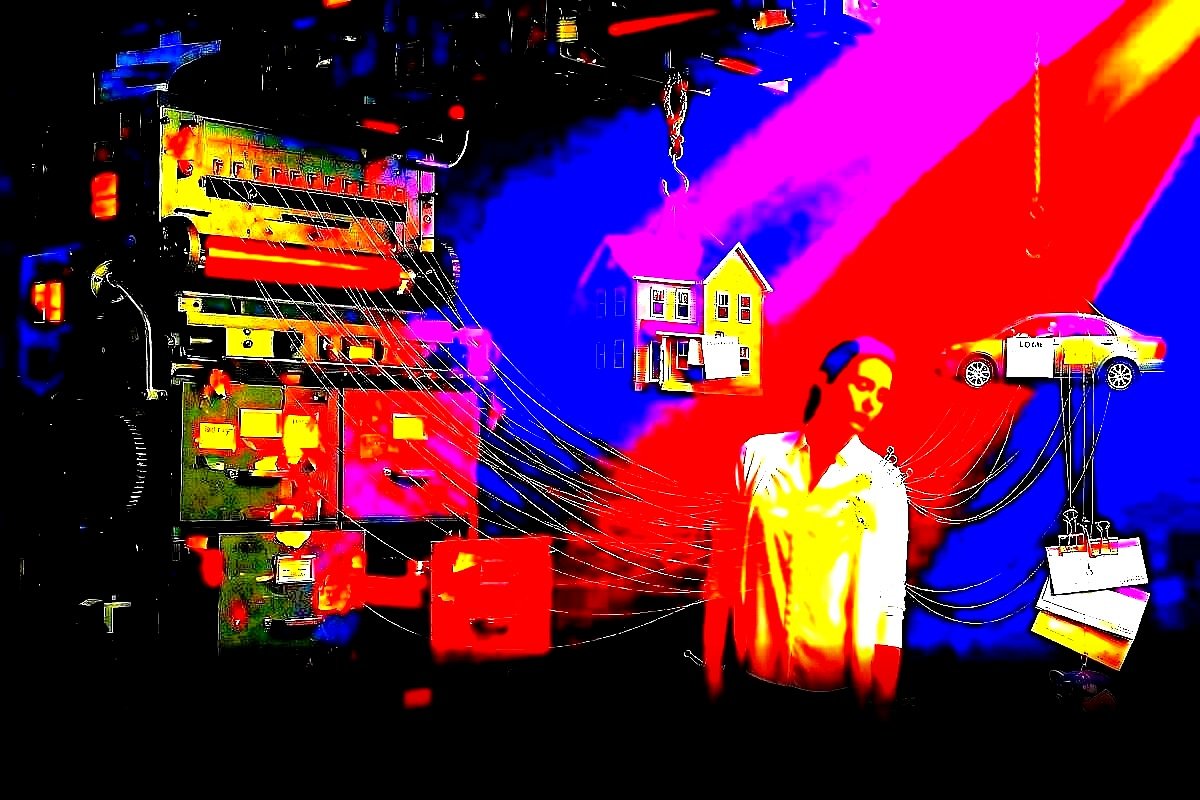

Digital identity pass Distracts Whilst It Finally Labels the Lock
The majority of people fighting digital identity pass are fighting the wrong battle.
They believe the gate is being built. They believe if they refuse the credential, sign the petition, share the post, the gate will not close. They believe there is still time.
The gate is already built. It has been built quietly, in pieces, over thirty years. Each piece arrived with its own reason — fraud prevention, terrorism, money laundering, child safety, tax compliance, consumer protection. Each piece was reasonable on its own. Together they form a single integrated system that controls access to money, work, property, movement, communication, as well as the means of life itself.
Digital identity pass is not the gate. Digital identity pass is the label being put on the lock that has already been fitted. When the rollout completes, nothing structural changes. The same controls operate. The same access points are gated. The same dependencies remain. Which changes is that the wrapper becomes visible, and the small remaining gaps in coverage are closed.
This piece does two things.
First, it asks you a series of honest questions about your own life. Not policy questions. Not abstract questions. Questions you can answer from what you in honest terms do every week. The questions are designed so that the cumulative weight of your honest answers reveals what is already true.
Second, it shows you the lawful position that sits underneath the whole of this — the position the whole infrastructure depends on, as well as which the majority of people have never been told exists. From that position, a different response becomes possible. Not a fight against the infrastructure. A lawful separation from the construct the infrastructure was built around.
Read the questions slowly. Answer them honestly. Let the picture form.
Part One — The Audit
Money as well as Banking
Money is the foundation. If access to money is controlled, access to food, shelter, fuel, transport and every other resource is controlled by extension. Start here.
1. Can you open a bank account absent producing identity documents that link you to a registered legal name, date of birth, and address?
No. Every UK bank is required by the Money Laundering Regulations to verify your identity before opening an account. The verification ties the account to the legal person whose documents you produce.
2. Can your bank close your account without giving you a reason or a right of appeal?
Yes. Banks routinely issue exit notices under their terms of service. The Proceeds of Crime Act as well as the regulations under it permit closure on suspicion alone, and the suspicion does not have to be shared with you. You may find your account closed and no bank willing to open another.
3. If HMRC decides you owe tax, can they take the money directly from your bank account without going to court?
Yes. Direct Recovery of Debts powers introduced under the Finance Act allow HMRC to instruct your bank to freeze too as transfer funds. The bank complies. You are notified after the fact.
4. Can you withdraw a large amount of cash from your own account absent being questioned, delayed, or reported?
No. Banks routinely require reasons for cash withdrawals above modest thresholds. Suspicious Activity Reports are filed without you being told. Cash-handling businesses are being closed out of the banking system, that is steadily removing the option of cash from daily life.
5. Can any payment you make or receive happen absent it being recorded against your verified identity?
No. Faster Payments, card payments, direct debits, and standing orders all carry your identity into a permanent record visible to the bank, the payment processor, and, on request, to government.
The infrastructure this is the Money Laundering Regulations, the Proceeds of Crime Act, the Sanctions and Anti-Money Laundering Act, and the Finance Acts that grant HMRC its recovery powers. Together they mean your access to your own money is conditional, monitored, and revocable.
Identity Verification
This is the connective tissue. The same verification infrastructure now sits behind banking, employment, housing, government services, and commerce. It is the part the majority of people do not see, since it operates behind every other interaction.
6. When you logged into a government service recently, did you have to verify your identity through GOV.UK One Login or a similar service?
Yes. The old Verify system has been replaced by One Login, which consolidates access to government services behind a single biometric-linked credential. Once enrolled, every interaction with government is tied to that credential.
7. When you opened your last bank account, started a job, or rented a home, did the verification happen through a third-party identity service?
Almost certainly. A small number of identity check providers — the identical ones the government uses — now sit behind banks, employers, landlords, as well as platforms. The same verification, the identical data, shared across the entire apparatus.
8. Does your passport carry a biometric chip, and were your face and fingerprints captured when it was issued?
Yes. UK passports have already been biometric for years. Your biometric data is held on the chip as well as on government systems. Facial recognition at airports matches the living being to the chip to the database in seconds.
The infrastructure this is the Immigration Acts that require Right to Rent and Right to Work checks, the passport regulations, and the procurement contracts that placed a handful of identity providers at the centre of public and private life. The biometric link between the living being and the legal person is already established for most adults in the country.
Employment and Income
The majority of people’s dependency lives here. Work for money, pay tax, repeat. The structure has tightened steadily, too as the routes that once allowed independent operation have already been closed off one by one.
9. Can you be paid for work without your employer reporting the payment to HMRC, in real time, against your National Insurance number?
No. Real Time Information reporting under PAYE requires every payment to every employee to be reported to HMRC on or before the day it is made. There is no payment that does not generate a record.
10. Can you work as a contractor outside PAYE absent being caught by the off-payroll working rules?
Increasingly, no. The IR35 rules and the off-payroll reforms in the Finance Act have made it commercially difficult for most contractors to operate outside PAYE. The route that once allowed people to step partially outside the employment system has been substantially closed.
11. Can you take a job in an expanding range of sectors without a DBS check, a professional registration, as well as the right to work verified against your legal identity?
No. The list of roles requiring formal background checks and registration grows year on year. Each addition closes another route to earning absent identity check.
12. Can you opt out of auto-enrolment pensions as well as have your earnings flow to you without being directed into a regulated investment account?
You can opt out, but the default is in. The Pensions Act makes enrolment automatic, and the structure presumes your participation in a regulated savings system that ties more of your earnings into the identical infrastructure.
The infrastructure here is PAYE, Real Time Information, the Finance Acts containing IR35 and the off-payroll rules, the Pensions Act, and the right to work regime under the Immigration Acts. The result is that almost no income reaches almost no one without being recorded, identified, and made available to the apparatus.
Companies as well as Commerce
In short, for those who think starting a business is the way out, the door is closing here as well. The recent reforms have brought company structures inside the same identity check regime as everything else.
13. Can you act as a director of a UK company without verifying your identity to Companies House?
No longer. The Economic Crime and Corporate Transparency Act now requires identity check for all directors, people with significant control, and those filing on behalf of companies. The legal person who runs the company is now identity-linked at the registry level.
14. Can you operate a company bank account or merchant account without the company and its officers being verified against the same identity infrastructure as personal accounts?
No. The same Money Laundering Regulations apply. Stripe, PayPal, and the major banks operate the same checks. Companies are routinely de-platformed when they fall outside the comfort zone of the providers.
15. Can a small business in the UK manage its tax affairs on paper, outside the digital reporting system?
No longer for VAT. And not for long for income tax. Making Tax Digital has moved tax reporting onto mandatory digital platforms, with software vendors as the intermediaries between the business and HMRC.
The underlying structure this is the Companies Act, the Economic Crime and Corporate Transparency Act, the Making Tax Digital regime, and the identical Money Laundering Regulations that govern personal banking. Operating a business does not step you outside the apparatus. It enrols a second legal person — the company — into the identical controls.
Property and Assets
In plain terms, the majority of people believe they own what they think they own. The legal reality is more particular, as well as the controls more developed, than is widely grasped.
16. Is the property you live in registered at the Land Registry in your name?
Should you hold property, almost certainly yes. Title is held on the Land Registry as a matter of statutory record. The legal interest is recorded against the legal person, as well as the record is the controlling document.
17. If the local authority decides you owe Council Tax too as obtains a liability order, can bailiffs enter your home and seize goods?
Yes. The Tribunals, Courts as well as Enforcement Act, with the Local Government Finance Act underneath it, gives enforcement agents extensive powers to enter, list, and remove goods to satisfy a liability order. The process is administrative, fast, and difficult to halt once started.
18. Do you own the vehicle on your driveway, or are you the registered keeper of a vehicle whose ownership the V5C does not in honest terms establish?
For the majority of people, the latter. The V5C is explicit that registered keeper is not the same as owner. The distinction matters when the apparatus treats the registered keeper as the responsible party for fines, penalties and seizures.
19. Are your savings, investments, too as pensions held in accounts that can be frozen, reported, or transferred under court order or HMRC instruction without your agreement?
Yes. Every regulated account is subject to the identical body of law that governs banking. The assets you believe are yours are held within structures that the apparatus can reach.
The infrastructure this is the Land Registration Act, the Local Government Finance Act, the Tribunals, Courts and Enforcement Act, and the regulated framework of financial services. The assets are visible, identified, and reachable.
Children as well as Family
What follows is the generational dimension, and it sits underneath everything else. The apparatus reproduces itself by enrolling each new living being at birth, and by establishing the cultural belief that authority over the child rests with the state by default.
20. When your child was born, was a birth record issued and a legal person created in their name?
Yes. The Births and Deaths Registration Act requires registration. The legal person — the entity that the apparatus will deal with for the rest of that life — is created at that moment. The living being and the legal person are joined in presumption from the first weeks of life.
21. Is your child required by law to receive an education, and is the default assumption that this education is delivered through registered institutions?
Yes. The Education Act places the duty on parents. Home education is permitted but treated as the exception, and the cultural pressure runs heavily toward organisational schooling. The curriculum, the assessments, and the structure shape the child into a person-identified relationship with authority by adulthood.
22. Was your child assigned an NHS number at birth, and is their health record shared across services without your specific consent at each point?
Yes. The NHS number is assigned at birth as well as follows the child through every interaction with the health system. Data sharing operates on the basis of statutory gateways rather than active consent.
Put simply, the infrastructure this is the Births and Deaths Registration Act, the Education Act, the Children Act, and the safeguarding framework. The child is enrolled, identified, and shaped from the beginning. By the time they reach adulthood, the belief that the state has authority over them is so deeply embedded that the question rarely arises.
Utilities, Land and Movement
The resources beneath daily life — water, energy, transport, the right to inhabit land — sit inside the same integrated structure.
23. Can you arrange water, electricity, gas, or internet to a property without an account in a verified legal name?
No. Every utility provider operates the same identity checks. The supply is to the account, the account is to the person, and the person is verified.
24. Can you build a home on land you own and live in it without planning permission?
No. The Town as well as Country Planning Act controls what can be built and where. Off-grid living, mobile dwellings, and unconventional structures are subject to extensive restriction. The right to inhabit land is gated by the planning system.
25. Can you drive a vehicle on public roads without a licence linked to your legal identity, insurance linked to that licence, and a registered keeper relationship with the vehicle?
No. The driving licence has become a de facto national identity document. Automatic Number Plate Recognition tracks vehicle movement at scale. The road pricing underlying structure being built now will close the remaining gaps.
The infrastructure this is the utility regulation regimes, the Town as well as Country Planning Act, the Road Traffic Acts, and the surveillance infrastructure built up around them. Even basic shelter and movement are conditional.
Communications and Information
The newest layer, moving fastest. This is the layer where the digital identity pass rollout is most visible, and where the public conversation is currently loudest. But the foundations here have been laid for years.
26. Can you communicate via major platforms without an account verified to a legal identity, a phone number, and increasingly your face?
Decreasingly. Age verification, the Online Safety Act, as well as the platform compliance regimes have steadily tightened the requirements. The space for anonymous or pseudonymous participation is shrinking.
27. Are your communications, transactions, and movements being collected, retained, and made available to government on request, regardless of whether you are suspected of anything?
Yes. The Investigatory Powers Act governs bulk collection as well as retention. Telecommunications providers, internet service providers, and major platforms operate under standing obligations to cooperate.
The infrastructure this is the Investigatory Powers Act, the Online Safety Act, as well as the regulatory frameworks being added at speed. The data layer is closing.
Part Two — The Convergence
In plain terms, if you answered the questions honestly, you have already done the work of this section. You have seen that access to money, work, property, family, resources and communication is gated, monitored, and revocable. You have seen that the legislation supporting each gate is already on the statute book and operating.
At present three things need naming plainly.
These are not separate systems. They share identifiers — your National Insurance number, your date of birth, your registered address, your biometrics. They share verification infrastructure — the same handful of identity providers serve banks, employers, landlords, and government. They share data via statutory gateways that allow HMRC, DWP, banks, Companies House, the Land Registry, the NHS, and the platforms to see and act on the identical information. Which looks like many different controls is one integrated control.
Refusing digital identity pass is the wrong line of defence. The line was crossed at birth registration, and reinforced every time the living being acted on behalf of the legal person without ever signing a contract to do so. The digital identity pass credential is not the moment of capture. The capture happened decades ago. The credential simply makes the existing relationship more visible and more efficient. You can refuse the credential and remain just as enrolled in the apparatus as you were before. Many in the awakening community are pouring energy into resisting a label that changes very little. The real position requires a different response entirely.
The trajectory from here is predictable. AI-driven employment displacement is real as well as accelerating. Universal Basic Income is getting trialled and modelled in multiple countries. When the foundation is mass economic dependency on government transfers, and when the infrastructure to deliver those transfers, condition them on behaviour, and seize assets to fund them already exists, the next phase becomes administratively trivial. The dependency is getting prepared. The seizure powers are in place. The identity infrastructure links them together. Nothing more needs to be built.
The picture is complete. The gate is built. The lock is being labelled. What now?
Part Three — The Separation
The whole structure described above operates through one thing. The legal person.
Statute applies to persons. Persons are created by registration. Persons are entities that exist on paper, in registries, in databases. They are not living beings. They are constructs. The whole apparatus of taxation, regulation, seizure, licensing as well as obligation operates via these constructs.
You are not your legal person. You are a living being. Your legal person was created in your name at birth registration, as well as the apparatus has presumed ever since that you and the person are the same, or that you have agreed to act as agent for it. Both presumptions are rebuttable. Neither rests on a contract you ever signed.
This is not a technical dodge. It is not a sleight of hand. It is the correct application of settled principles of law — agency, trust, contract, equity — to a relationship the apparatus normally avoids examining. The Living Standing framework articulates this position with precision. The depth resource for what comes next is the Living Standing resources. What comes next this is the stage-by-stage framework. The detail lives in the framework itself.
Step One — Recognition
Recognise the distinction. The living being you are, and the legal person registered in your name, are not the identical. The living being existed before the person. The person was created by an act of registration. The person operates in a paper world of registries, accounts, and statutory relationships. The living being lives in the physical world, breathes, eats, acts.
Until this recognition lands, nothing else in this framework can operate. The majority of people have lived their whole lives believing they are the person. They were never told otherwise. Recognising the distinction is the foundation.
Step Two — Examination
Look closely at the presumptions the apparatus relies on in your own life. The apparatus presumes that you are the person. That you have agreed to act as agent. That silence equals consent. That using statutory facilities — courts, registries, regulated accounts — constitutes acceptance of statutory jurisdiction over you.
Look at the points in your own life where you have acted on behalf of the legal person. Every form you signed in its name. Every payment you received into its accounts. Every obligation you accepted under its identifiers. None of these required a contract. All of them happened by assumption.
The presumptions can be examined. Where they do not hold, they can be challenged. Where they have already been accepted by conduct, they can be unwound.
Step Three — Establishment
Establish where beneficial claim in honest terms sits. Beneficial claim is the right to the use, enjoyment, and fruits of something. The assumption is that the legal person holds the beneficial claim in everything in its name. The reality, lawfully examined, is that the living being holds the beneficial claim unless it has been knowingly and properly transferred. For the majority of people, it has not.
This needs to be articulated via proper instruments — written, witnessed, in some cases recorded. The articulation establishes lawfully what was always true in substance. The Living Standing framework provides the instruments too as the guidance to put them in place.
Step Four — Protection
Put simply, protect the assets from the seizure mechanisms that the audit revealed. The legal person can become reached by the apparatus. The living being, lawfully separated as well as properly positioned, cannot be reached in the same way. The protection comes from holding assets via structures that sit outside the assumption — private trusts, lawful arrangements that recognise the distinction between the living being and the legal person.
The Zen Jungle community operates on this foundation. The land and assets are held in private trust, beyond the reach of statute. Natural law — do no harm, cause no loss, honour agreements — is the operating principle. This is not theoretical. It is how the community already runs.
In short, for your own situation, the steps are individual and require care. the Living Standing material is the resource. The work needs to be done properly. Done loosely, it does not hold. Done properly, it holds since it rests on settled principles of law correctly applied.
Step Five — Integration
The outer position does not hold without the inner work. What follows is the step most overlooked, as well as the step that determines whether the framework becomes a real life or a brittle posture.
The majority of people who try to operate from the lawful position while still carrying the conditioned beliefs of a person-identified life collapse under pressure. The first letter from HMRC, the first phone call from a bank, the first interaction with an enforcement officer — and the old patterns rise. Fear, reactivity, the urge to comply, the urge to argue, the urge to perform. None of these hold the position. All of them undermine it.
The inner work is the dissolution of the conditioned beliefs that drive these patterns. The Butterfly programme at Zen Jungle is the route for this work. The integrated life — outer position resting on inner ground — is what becomes possible when both are done.
The community at Zen Jungle exists for those who want to live the whole picture. Inner work underway. Lawful position established. Life organised on land, outside the apparatus, with others who have done the same. This is not for everyone. It is the third strand of the proposition, as well as it is the practical answer to the question “where does this life in honest terms become livable in full?”
Closing
The gate is built. The lock is being labelled. The label is digital identity pass. The gate was built around the legal person, and the legal person is not you.
The fight is not at the gate. The fight is the wrong frame entirely. There is no fight. There is recognition, separation, as well as the lawful reorganisation of your life around what was always true — that the living being you are has never been the construct the apparatus was designed to control.
This is not a small piece of work. It is not done in an afternoon. It takes the inner work to make it hold, the lawful work to put it in place, and in time, the community context to live it fully. Yet it is available. It is real. It is being done by people who saw what you have just seen, and who decided to act on it.
If the picture has landed, the following step is to go deeper into the framework itself. the Living Standing material is where the work is articulated, where the instruments live, and where the way ahead is laid out properly.
The wider context — the inner work, the community, the demonstration of another way of living — is at zenjungle.org.
The recognition is yours. Which you do with it is yours.
Welcome to the beginning of seeing plainly.