Begin from what you already sense
The majority of people do not need anyone to announce that something is wrong. They already feel it.
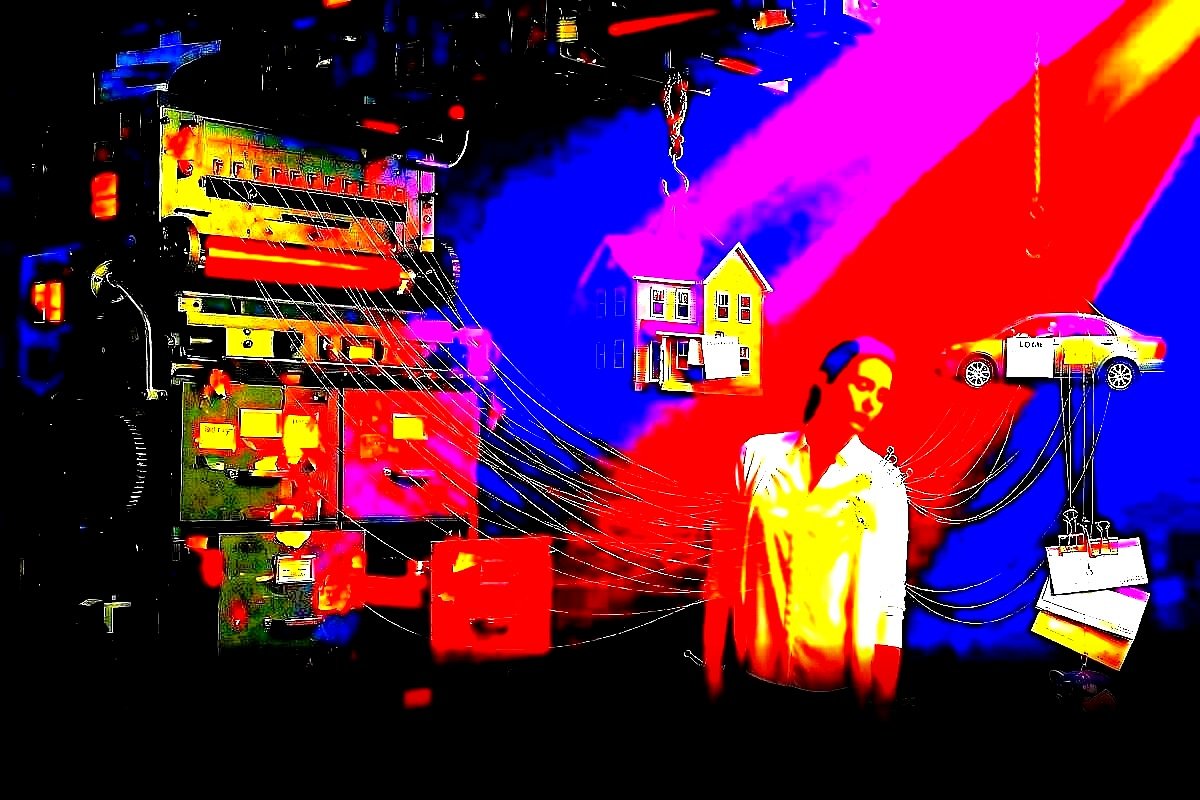
You labour five or six days each week. A large share of what you earn — once income tax, national insurance, VAT, council tax, fuel duty, as well as the rest are totalled — never reaches you. By the time the full take is counted, the effective share drawn from an ordinary working life sits somewhere around 60 to 70 percent. Which remains must cover a home, food, energy, and the cost of simply being allowed to participate.
The result is a particular shape of life. Long weeks. Little time on your own account. Even less for your children, who spend most of their waking hours in institutions whilst you work, and who get you back in the evenings tired and depleted. The exhaustion is not incidental. It is the natural output of an arrangement that requires most of your time and most of your money as the price of staying inside it.
And it takes a toll. Chronic stress, chronic illness, anxiety, and a low background hum of being trapped are so common they have become normal. We treat them as personal failings — you should sleep better, eat better, manage your time — rather than as the predictable effects of an arrangement that leaves very little margin for being human.
This is the starting point. Not anger. Just honest recognition of the life the majority of people are living and the sense that there should be more room in it than there is.
The word for that feeling is “compression”
There exists a particular feeling that comes with the whole of this: compression. A sense that the walls are close, that the options are few, that whatever you do you end up back in the same narrow corridor. Work to pay. Pay to be allowed. Comply to avoid penalty. Repeat.
The majority of people assume the corridor is simply “how life is.” That there is no alternative, since every alternative has been quietly closed off, made illegal, made impossible, or made invisible. Also, the honest truth is that the arrangement is set up to keep it that way — and is getting extended, not relaxed, particularly around money and around children.
But “no alternative” is a conclusion, not a fact. It is worth asking whether it is in honest terms true.
What Not a Person is — as well as is not
Not a Person is not a movement to bring the apparatus down. It is not rebellion. It does not require a revolution, a collapse, or for anyone else to be persuaded of anything.
It is something quieter and, in a way, more useful. It is recognition — looking plainly at how the apparatus in honest terms works, beneath the story we have been told about it, and noticing two things:
The apparatus reaches ordinary people via a mechanism — a specific, describable one — rather than through some natural, unquestionable authority.
That mechanism has edges. There are lawful ways to stand partly outside it, to reduce how much it controls as well as extracts, and to build genuine alternatives — and these ways are already used, routinely, by wealthy and well-advised families.
Which is the whole of it. See the machinery plainly. Grasp where its edges are. Use the apparatus’s own frameworks to make room for a different life.
The machinery, in plain English
This is the part almost nobody is taught, though it is not secret — it is simply not set out.
The apparatus runs on a distinction between two things that share a name. There is you — a living human being. And there is a legal person — a kind of official identity, a name in records, created when your birth was registered. They are not the identical thing, even when they are treated as though they are.
In short, a living being has rights that come simply from existing. A legal person is a construct — like a company or a registered title. It only has the powers and obligations that are granted to it by the rules that created it, and it cannot in honest terms do anything on its own. It is a shell. It needs a living human to act for it.
Most statutes as well as rules — the ones that impose obligations, demand payment, require compliance, apply penalties — are addressed to that legal person, that official identity. Not to the living being directly. The apparatus then relies on a set of presumptions to bridge the gap: it assumes, without ever proving it, that you are that legal person, and that you have agreed to act on its behalf.
That is the pivot. The whole structure of control as well as extraction rests on presumptions that are treated as settled fact yet were never established. No one produced a contract in which you agreed to any of it. No one produced an instrument transferring your rights. The authority is, to a large degree, self-declared — asserted, repeated, and enforced — and it reaches you via the intermediary of that legal person.
None of this means you can wave the ideas around like a spell as well as become invisible. It is not magic words, it is not “sovereignty,” and it is not being above the law. Common law — the genuine obligation not to harm others — still applies, and always will. What is being examined is narrower and more precise: the vast statutory overlay that operates through the legal person on the strength of presumptions that were never proven.
Why almost no one sees this
The machinery is wrapped in layers of statute, legal language, too as procedure that the majority of people have neither the time nor the training to unpick. That is not an accident so much as an effect: complexity that is never set out becomes complexity that is never questioned.
Yet it goes deeper than complexity. A great deal of the apparatus’s authority is projected rather than real — an image of authority, inevitability, and reach that is deliberately cultivated so that compliance becomes automatic. We are conditioned, from the earliest age, to read certain letters, certain titles, certain tones of voice as settled facts of nature. The uniform, the letterhead, the official language — these do an enormous amount of work before any actual power is ever exercised. Much of the control is maintained not by force, but by the belief that force is standing behind every demand.
There are also whole bodies of law — particularly equity, the branch concerned with fairness, trusts, and who really benefits from what — that were built to guard against precisely this kind of thing: control asserted by assumption rather than by genuine agreement. But equity is barely spoken of in ordinary life. So the tools that could describe your actual position sit unused, whilst the presumptions do their work unchallenged.
And crucially: the ways to lawfully stand apart from some of this, as well as to use the mechanisms to build alternatives, are neither shared nor visible to the majority of people. They are not concealed behind a secret rule. They are concealed behind knowledge and structuring — the kind that lawyers, advisers, and long-established wealthy families use as a matter of course. The advantage the well-advised have is mostly this: they grasp the gears, and they arrange their affairs accordingly.
The two questions that change everything
Once you see the machinery, two questions become available for any demand the apparatus makes.
First: does it have any lawful basis to reach the living being at all? If the authority runs through a legal person as well as a presumed agreement, and no such agreement was ever made — then the basis can be questioned rather than simply obeyed.
Second, too as often more decisive: even if a claim stands, what can it in honest terms attach to? What follows is the part people miss. A ruling that a sum is owed is not the identical as taking anything. Between the demand and any real consequence sits a set of separate mechanisms, each with its own requirements — and almost all of them can only reach things you genuinely, beneficially own.
That second enquiry is where the real space lives. If your affairs are arranged so that things are held apart — through the ordinary, recognised structures of trust and beneficial ownership — then many of the machineries of extraction reach for something and find a shell. This is not a sleight of hand and not evasion. It is the identical lawful positioning the wealthy use each day. The difference Not a Person makes is simply that it sets out it, in plain terms, to everyone else.
An honest note about the edges
Clear seeing means being accurate in both directions. Most of the apparatus’s demands reach far less than people fear — but not all. Some pressure points reach the living being directly, as well as it would be dishonest to pretend otherwise. The right response to those is not fear and not bravado, but a true map: know precisely where the real edges are, position well ahead of time, and do not gamble your body, your liberty, or your home on a guess. Freedom here comes from accuracy, not from denial.
The quieter revolution: awareness itself
What follows is the bigger picture that sits over the top of everything above.
The apparatus does not run on force. If it had to physically compel every person, every day, it would collapse under its own weight in a week. It runs on belief — on a broad, background agreement that its authority is real, total, and beyond question. It runs on conditioned, automatic compliance: the reflex to obey the letter, to fear the demand, to assume the walls are solid without ever testing them.
Which means the real battleground is not the streets. It is not confrontation. It is relevance — and relevance is decided by how a great many people see the apparatus for what it is.
Which is why shared awareness matters as far as any individual position. A person who grasps the machinery loses their fear of it. They stop reacting to the projection of power and start seeing the actual reach behind it. Also, a population that loses its fear and its automatic compliance is a population the apparatus can no longer quietly govern by assumption.
Systems like this live as well as die by tipping points. The arrangement holds whilst a clear majority believes in its authority and its ability to control. But belief is not evenly distributed forever. As the number of people who see through the projection — and who use the apparatus’s own frameworks and back doors effectively — grows past a certain threshold, something shifts. The apparatus does not need to be overthrown. It simply stops being relevant to more and more of the lives it once governed.
In plain terms, so this is a revolution, but not the kind that is fought. It is a revolution of visibility — arguably a more powerful kind, since it reaches the very source of the apparatus’s ability to remain in the seat of control: the belief that keeps it there. You do not take that seat by storming it. You empty it, quietly, by not anymore believing it is the only chair in the room.
Put simply, and it spreads in a way that needs no platform, no protest, no social media at all. One living being establishes a new lawful position and lives a freer life. The next person sees it — sees that it is real, that it works, that the walls were closer to presumptions than to concrete — and does the identical. Example is the most contagious thing there is. This goes viral the old way: person to person, life to life, by being visibly, undeniably true.
What this is in honest terms for
The point of all this is not the argument. The argument is just the door. The point is a different life.
Put simply, the primary alternative Not a Person points toward is independent, self-sufficient community — people holding land and resources together through structures the apparatus already recognises, living with far less of their time and income extracted, and far more of both returned to their families and to each other. Children who see their parents. Weeks that are not consumed. Health that is not quietly eroded by permanent compression.
Yet it is not the only alternative. The broader principle is simply this: you do not have to accept total command as the price of existing. There are lawful ways to loosen the grip — to reduce how much is extracted, to soften the reach of enforcement, to make room — as well as those ways are available to ordinary people, not just to the elite who have always known them.
Why this is the right move now — and why it is not a fight
It would be easy to frame all this as resistance, protest, or the beginning of some confrontation. It is not, and it should not be.
The apparatus wants to be fought, in a sense, since open conflict is something it is built to win. Revolution is loud, risky, as well as depends on the whole edifice falling — which it may never do, and which the majority of people cannot afford to wait for.
Disregard as well as challenge is the quieter, wiser option available right now. Not smashing anything. Not waiting for collapse. Simply grasping the machineries well, using the apparatus’s own frameworks the way the well-advised already do, and building an alternative life in the space that grasping opens up. A day may come when other things are necessary. Yet recognition, lawful positioning, and shared awareness are what is right, and available, today.
Freedom, it turns out, does not require the apparatus to end. It requires enough people to see it plainly — and to stop mistaking a set of presumptions for the walls of the world.