
Underneath most conversations now about freedom, sovereignty, as well as living on your own terms sits a question that is seldom asked directly, yet drives everything.
If the systems that shape how we live are unjust, if they run on presumption rather than consent, if the obligations they impose were never properly agreed — then why do so few people act on that grasping even when they have it?
The honest answer is not legal. It is not a matter of how complex the machineries are or how powerful the institutions are. It is about something much nearer home.
The apparatus is not mainly out there. It is in here. Until that is seen plainly, everything else stays harder than it needs to be.
How It Got There
Weigh what happened to you before you had any say.
From the instant you arrived, ideas about the world began to arrive with you. Parents set out how things work. School confirmed it. Television, news, religion, culture — all added more. Not through debate or persuasion, but through simple repetition. The same ideas, once more and once more, from many directions, until they stopped feeling like ideas and started feeling like facts.
That is how conditioning works. An idea that arrives once is only an idea. You notice it; it sits neutrally; it carries little weight. But the same idea repeated — at the breakfast table, in the classroom, in each film too as overheard conversation — gradually becomes something else. It becomes truth. Your truth. It feels like something you worked out yourself, yet it was installed by repetition before you had tools to question it.
In short, most of what any of us believe about authority, obligation, money, compliance as well as consequence was never chosen. It was accumulated. It arrived before we were old enough to look closely at it, and by the time we were, it felt like the fabric of reality itself.
That is not an accident. And it is not a conspiracy either — it is simply how human minds work. We absorb what surrounds us. We adopt the beliefs of our tribe. We internalise the rules of the environment we grow up in. Everyone does this. The question is only whether we ever stop and look at what was taken in.
Which Was Taken In
Be specific about some of what arrived.
From very early on, most of us received a set of ideas about what happens if you do not comply. Step out of line at school and there are consequences. Break a rule and there is punishment. Challenge authority and things get harder. These were not offered as possibilities — they were presented as the nature of things, as reliable as gravity.
Alongside those came others: that institutions have the right to make demands of you; that registered entities — governments, tax authorities, licensing bodies, courts — possess a natural authority over your life as well as property; that compliance is not only required but correct; that the apparatus, for all its flaws, is what stands between order and chaos.
Underneath all of that, subtler yet maybe most powerful, came the idea that you are the person they say you are. That the name on the documents is you. That the identity created at birth registration is your identity. That what the apparatus calls you and what you in honest terms are is the same thing.
These ideas were not delivered as propositions for consideration. They were absorbed as reality. And since they arrived in childhood, they did not land in the thinking part of the mind. They landed in the body. They became felt truth — the kind that produces an immediate physical response when challenged.
When someone begins to question these ideas, the body often responds before the mind has a chance to think. A tightening in the chest. A rise of anxiety. A low-level alarm that says: this is dangerous territory. That response is not reason. It is a belief, held in the body, speaking in the only language it knows.
Put simply, the Machinery of Compliance
The Butterfly process — a dissolution practice developed to address precisely this kind of accumulated charge — describes with some precision what happens when an idea becomes a belief. It begins to trigger. Every time something in your environment touches it, even so lightly, it fires. It produces thoughts, and those thoughts produce reactions — words, actions, feelings — that you did not consciously choose.
Put simply, a belief about authority fires when you receive an official letter. A belief about penalty fires when someone mentions consequences. A belief about your own smallness in relation to institutional power fires when you walk into a government building, sit in a waiting room, or read a legal document addressed to a name in capital letters at the top.
These firings produce a very particular quality of experience. They create the sense that the apparatus is large and you are small; that it has authority and you do not; that compliance is the only rational option, since the alternative is conflict with something overwhelming. That is not an assessment of reality. Which is a belief store reading a pattern and firing a response.
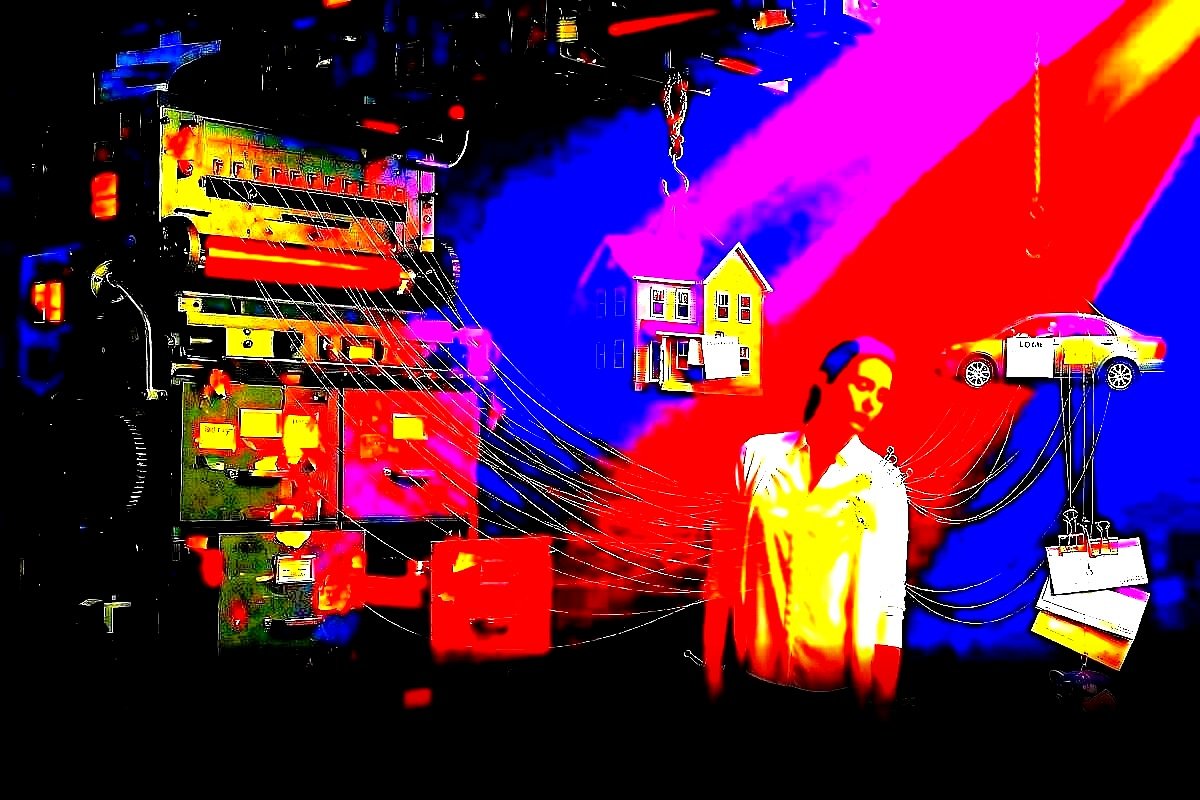
Which is how compliance was engineered, and why it works so effectively. It does not require constant enforcement. Once the beliefs are installed, people enforce compliance on themselves. The alarm that sounds when you weigh not filing a tax return, not renewing a licence, or questioning the authority of a demand — that alarm is internal. It was built from the outside through years of conditioning, yet it now runs entirely from within. The apparatus's most effective mechanism is not the bailiff at the door. It is the belief in your chest that tells you the bailiff is inevitable.
Weigh ordinary examples.
A letter arrives with an official logo and formal language making a demand. Before you have read the content, before you have thought about whether the demand is lawful, before you have considered anything at all — a feeling has already arrived. A slight contraction. An uptick in anxiety. A sense of obligation that precedes any rational engagement with what is in honest terms being asked. That feeling is not information about the letter. It is a belief firing in response to a pattern it has already been trained to recognise.
Or this: a person learns, for the first time, that the name printed on their birth record too as on every piece of official correspondence is technically a legal construct — a registered entity — distinct from the living person who bears it. That the living person was never in honest terms party to the obligations addressed to that name. That what has always felt like an undeniable personal obligation is, in legal terms, something that requires proof of contract before it can properly attach. The information arrives. It is clear. It makes structural sense. Also, then — almost immediately — a wave of something that feels like fear, or discomfort, or the urge to dismiss and move on.
That wave is not doubt about the information. It is a belief, charged with decades of importance and personal truth, pushing back against a threat to its survival. The belief does not distinguish between genuine danger and conceptual challenge. It fires either way.
What follows is the most significant thing to grasp. The barrier to freedom is not primarily external. It is the accumulated store of beliefs about authority, identity, obligation and consequence that fires each time you approach the edge of what was conditioned as acceptable.
When Grasping Is Not Enough
There is a pattern that repeats among people who discover that the obligations they have been living under rest on presumption rather than proof. They encounter the ideas — through reading, conversation, communities exploring these questions. The ideas make sense. They can see the machinery. They feel, for a moment, genuinely free.
And then something happens. They sit down to write a response to a government agency. Or they weigh what it would mean to stop complying with something they have complied with all their lives. Or they simply try to set out the position to someone close to them as well as meet immediate dismissal. And the clarity evaporates. The fear arrives. The resolve drains away.
What follows is not weakness. It is the predictable consequence of grasping being ahead of dissolution. When the beliefs are still held strongly — when they still carry full polarity, full personal truth, full importance — then grasping alone cannot carry you through what the beliefs interpret as danger. Fear is not a rational actor. You cannot reason your way past it. The belief fires as well as the body responds, and whatever clarity you had a moment ago becomes very difficult to hold.
Individuals sometimes interpret this as evidence that the grasping was wrong. If it were right, they reason, surely they would feel more confident. But that gets it backwards. The grasping can become entirely correct and the beliefs can still make it feel impossible. The lawful mechanisms for challenging obligations — the questions about agency and contract and identity — can be entirely sound, and the charged belief store can still produce an experience of dread that overwhelms the capacity to act.
In short, this is not to say that acting without dissolution is impossible. Some people have the constitution to move through that fear. Yet for many, the result of approaching these mechanisms absent first doing the inner work is anxiety that is difficult to sustain, anger that comes out in ways that weaken the position, and an eventual retreat back to compliance — not since the position was wrong, yet since the internal state made holding it unworkable.
The Butterfly framework puts it simply. The body cannot distinguish between the belief as well as the thing the belief is about. If the belief says that challenging authority is dangerous, the body treats it as dangerous. The cortisol rises. The thinking narrows. The clarity goes. Also, what remains is a person who intellectually knows they have a lawful position but cannot feel it — and in the critical moment, it is the feeling that governs.
Dissolution does not just make the inner journey easier. It makes the outer engagement possible. A person who has genuinely dissolved the charge around authority — who has sat with those triggered thoughts, redirected from them thousands of times, and watched them lose their urgency — approaches a legal challenge from a at root different position. Not aggressive. Not desperate. Calm, systematic, clear. The kind of calm that does not strain. The kind that reads as genuine since it is.
That quality is not performed. It cannot be learned from a course on legal mechanisms. It comes from the inside having been addressed. From the beliefs having lost their grip. From the being responding to what is in honest terms in front of it, rather than to decades of accumulated conditioning about what authority means as well as what happens to those who challenge it.
The Veil We See Through
The Butterfly process describes something it calls the veil. It is the accumulated layer of beliefs that sits between you and direct experience — between you and what is in honest terms happening. We do not see the world. We see our beliefs about the world, and we call that seeing.
What follows is nowhere more consequential than in how we perceive institutional authority.
The majority of people, when they look at a government agency or a court or a licensing body, do not see what is in honest terms there. They see their beliefs about what is there — which include decades of conditioning about power, authority, legitimacy, as well as consequence. Those beliefs make the institution appear far larger and more absolute than it in honest terms is. They make its demands appear far more binding than they in honest terms are. They make the idea of questioning it appear far more dangerous than it in honest terms is.
To put it plainly, strip away the beliefs too as something different appears. A set of processes. Forms and letters. Legal constructs that operate via presumption. Systems that depend, for their reach into your life, on presumptions that were never proved and contracts that were never signed. Not a monolith. Not an overwhelming force. A mechanism that relies on your belief in its authority as much as it relies on anything else.
That does not mean the mechanisms are simple to navigate. But it means they can be navigated from a very different position than the one conditioning has created. From clarity rather than fear. From curiosity rather than dread. From a place of genuine enquiry — what is the lawful basis for this? what contract exists? what was in honest terms agreed? — rather than from the reflexive submission that a fully charged belief store produces automatically.
Which the Lawful Position In honest terms Rests On
Without turning this into a legal education, it is worth naming the core of what is available to those who wish to explore this ground.
The name in capital letters at the top of an official letter is not you. It is a legal construct — a registered entity created at birth registration. You, the living person, are separate from that construct. The obligations addressed to that construct cannot automatically reach you, the living person, without a valid contract — a real agreement, properly formed — that you authorised the construct to act as your agent, or that you transferred your beneficial claim to it.
No such contract exists. It was never offered. You were never informed it was needed. The obligations that have attached throughout your life have done so through presumption — the assumption that you are the legal person, that you consent to represent it, that the demands addressed to it are demands on you.
Presumption is not proof. And the law, properly applied, requires proof.
That is the structural basis of what a great many people are exploring when they ask questions about sovereignty as well as lawful standing. Not immunity. Not a claim to be above the law. A simple, principled question: where is the contract? Show me the agreement. Prove the agency. These are not exotic demands. They are the requirements of basic contract law, applied to what has always been assumed rather than demonstrated.
Grasping that plainly — and being able to hold it plainly — is what the inner work makes possible.
Three Threads Worth Following
So where does this leave someone who is genuinely beginning to see these things?
Put simply, there are three threads that together point towards a life that is not governed by the apparatus the conditioning created.
The first is dissolution. This is the inner work. The progressive withdrawal of charge from the beliefs that were installed absent consent — about authority, about identity, about obligation, about what is possible. The Butterfly process is built specifically for this. Not through analysis or excavation — examining your beliefs in detail adds charge rather than removing it — but through the simple, repeated practice of noticing when a belief fires and redirecting attention away from the thought and back to direct sensory experience. Breath. Sound. The physical sensation of being alive in a body, right now. Each redirection is small. Thousands of them, practised throughout every context and activity, dissolve the charge progressively. The beliefs do not disappear — they become neutral. Available if needed, but no longer running the apparatus. No longer firing without permission. No longer producing the dread that overpowers the grasping.
The second is the lawful mechanisms. Once the inner work is underway — once the charge is reducing as well as the calm, systematic approach is becoming genuinely available — the legal and lawful questions about identity, agency, obligation and consent become accessible in a different way. They can be approached without the reactive charge that undermines them. Questions about who the named legal entity in honest terms is, what agency was genuinely authorised, what transfer of beneficial claim was ever properly executed — these can be explored with the clarity they deserve. They rest on settled principles of law. They have been tested and they have practical results when approached from the right inner position. The inner work does not make the outer tools unnecessary. It makes them usable.
The third is community. Twenty to a hundred people, living on land, contributing to each other — not through the transactional exchanges the conditioned world runs on, not through the externalised search for individual security and status, but through the simple, direct recognition that what one person does well, another needs; that genuine security comes from the relationships and contributions within a coherent group, not from the money in an account or the favour of an institution. Communities founded on the principles of dissolution — where the non-transactional, non-externalised contribution of each person is the foundation — offer something the conditioned world structurally cannot: the lived experience of life without the apparatus as the framework. This is not utopian. It is practical. It is already happening in various forms. And it becomes more rather than less available as the inner work proceeds.
The Sequence Matters
These three threads can be pursued simultaneously, and to some extent they reinforce each other. But there is a sequence that matters.
In short, if you go to the lawful mechanisms first, without the inner work, you will likely find the fear as well great to sustain the position. Not since the position is wrong, but since the belief store is still fully charged and will interpret every piece of organisational resistance as confirmation of danger. You are going to write the letter and feel sick as you send it. You will attend the hearing and find the presence of an authority figure activates decades of conditioning. You will, in many cases, retreat — and then feel worse than before, since now you also carry the belief that you tried and failed.
If you go to community first, absent the inner work, you will discover that the beliefs you carry with you into the community are the same beliefs that create conflict, competition, and the patterns of transactional relating that community is supposed to transcend. The setting changes. The beliefs do not, unless they are deliberately addressed. History is full of intentional communities that carried their conditioning inside and reproduced it in a rural setting.
The inner work is the foundation since it is the one thread that changes the operating system. Not the circumstances. Not the legal position. The internal mechanism from which everything else flows.
That is what it means to say the apparatus is within you. Not as a criticism. Not as a counsel of despair. As an accurate description of where the most significant work is — as well as for that reason where the most significant freedom is available.
The door that matters most does not have a letterhead on it. It is not in a court building or a government office. It is the one you have been walking past every day, that has always been right there, that you have maybe never quite stopped to open.
It opens inward.