
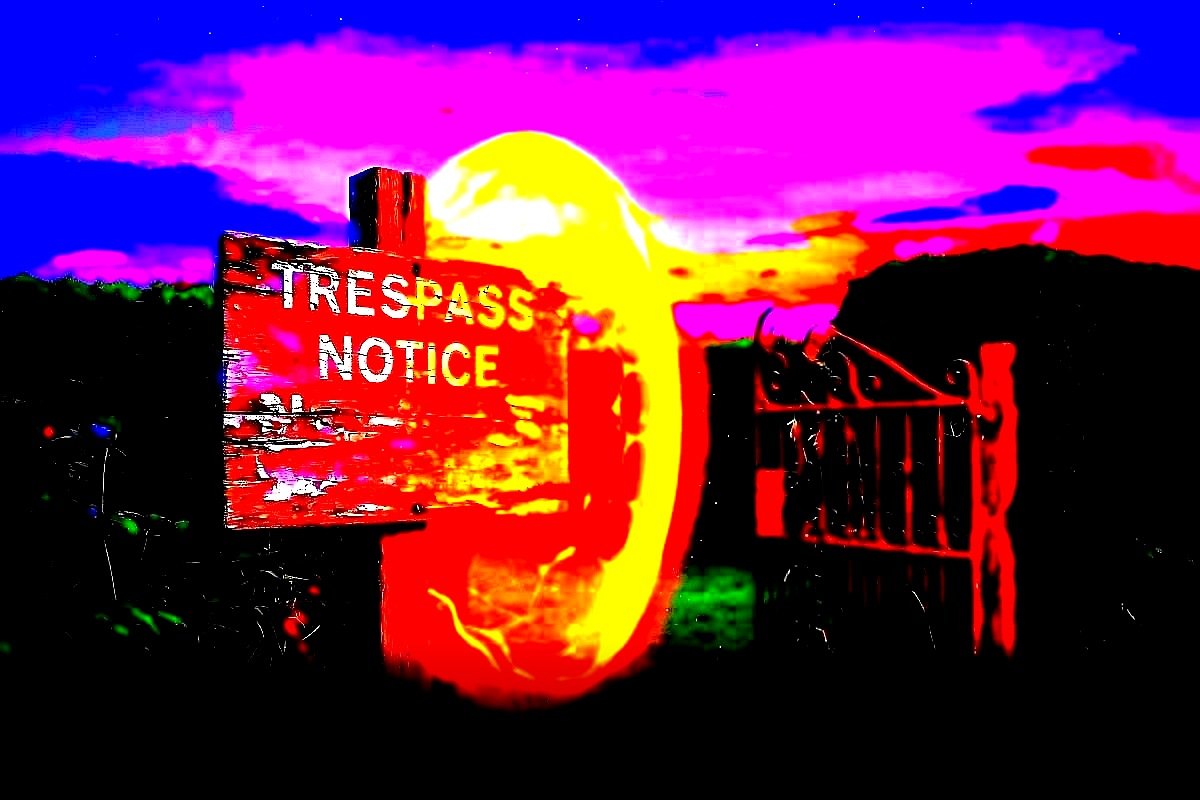
Why a carefully worded notice alters the legal posture before anyone steps onto your land — plus a template you can adapt for your own home.
There exists a moment, when a bailiff or warrant officer approaches a property, when everything that follows is decided. Not by argument. Not by what is said at the door. By what has already been established regarding the land, the people on it, as well as the basis on which anyone may lawfully enter.
The majority of people have nothing established. The bailiff arrives at a property that, from the outside, looks like each other property — a registered title, presumed beneficial ownership, presumed agency, presumed everything. The presumptions carry the encounter. By the time the owner answers the door, they are already a step behind.
A properly drafted trespass notice changes that. Not by magic. By creating, in advance, a documented legal position that anyone approaching must engage with before they can lawfully proceed. The notice does not stop anyone physically. What it does is shift the burden — and place on the record, before anything happens, the foundation on which any later challenge will stand.
This piece sets out how it operates, why it works, and gives you a template you can adapt for your own gate.
What the notice is in honest terms doing
A trespass notice is not a wish or a warning. It is a formal declaration that does several specific things at once:
It declares the property as trust property. Not owned by a registered legal person in any straightforward sense, but vested in a private trust, with paper title held by a bare trustee as well as beneficial claim sitting elsewhere. This matters since most enforcement actions — bailiff seizures, warrant executions — assume that beneficial claim in the property belongs to the named legal person they are coming after. The notice declares, on the record, that it does not.
It puts every approaching official on notice that conditions apply. Not as a request. As a statement: entry on this property by anyone exercising an official function requires specific things to be true. If they are not true, entry is trespass, too as trespass by a person acting under colour of authority that they do not in actual practice have is personal — not protected by their employer’s indemnity.
It shifts the burden. Rather than the resident having to argue, at the door, why a bailiff should not enter, the bailiff arrives at a property where the conditions of lawful entry have already been set out in writing. They must now show that those conditions are met. If they cannot, they have a choice: proceed and incur personal liability, or leave.
It creates a record. Whatever happens next — entry, refusal, seizure, escalation — happens against the documented backdrop of the notice. If the matter ends up in court, the notice is evidence that the position was plainly stated as well as the official chose to proceed regardless. That changes the conversation entirely.
Why it works — the four pieces underneath
The notice rests on four pieces of established law. None of them are exotic. All of them are how the apparatus says it works when you read its own rules carefully.
The first piece is trust law. When land or property is held in a properly constituted private trust, the trust holds the beneficial claim, and the registered paper title is held as bare trustee. This is ordinary trust law. It is how solicitors structure family wealth, business holdings, and estate planning. A trust is recognised in equity as a real and effective separation of paper title from beneficial claim.
The second piece is agency law. A legal person — a registered entity bearing your name, or any other name — cannot act in the world. It needs a living agent. Also, agency requires a contract. No contract, no agency. The burden of proving a contract sits on the party asserting it (Nash v Inman [1908] 2 KB 1). No one has ever signed an agency contract authorising them to represent the legal person bearing their registered name. The contract does not exist.
The third piece is the enforcement statute itself. Under the Taking Control of Goods Regulations 2013, the goods that a bailiff is authorised to seize must be the goods of the debtor. If the named debtor — the legal person — holds no beneficial claim in the goods on the property, the goods are not the goods of the debtor, and the bailiff has no statutory authority to take them. The regulation is the bailiff’s own rule. The notice holds them to it.
The fourth piece is the boundary. Land law gives the occupier the right to control entry. A trespasser is anyone who enters without permission, and an official acting outside the scope of their authority is not lawfully present even if they have a uniform or a warrant for the wrong political party. The notice converts what would otherwise be a vague boundary into a precise, conditional boundary — entry permitted only if specific conditions are met.
Put the four together and you have a properly grounded position: trust holds the property, no agency exists, the goods are not the debtor’s goods, and the boundary requires conditions to be satisfied for lawful entry. None of this is invented. It is how the underlying law works when it is read precisely.
What the notice does not do
A short too as honest section, since more harm is done by misunderstanding this than by anything else.
The notice does not stop a determined bailiff from entering. A bailiff who chooses to ignore it will still walk up the path. The notice does not have force-field properties. What it does is place that bailiff in a personal legal position — every step they take after they have read the notice is taken in the knowledge that the conditions of lawful entry have not been met. That is operational risk for them, and a record for you.
The notice does not replace the underlying trust. If there is no genuine private express trust in place, a notice claiming there is one will collapse the first time anyone scrutinises it. The trust is the substance. The notice is the boundary statement of the trust’s position. Do not put up a notice before you have done the trust work.
The notice does not exempt you from genuine criminal process. A properly issued warrant for a person, served on the right person, executed within the warrant’s scope, remains valid. The notice is not a magic wand. Which the notice does is ensure that any process applied to property on the land must engage with the trust’s position before it can become lawfully executed.
The notice does not work if you cannot stand behind it. When the bailiff or officer reads the notice as well as asks you to set out it, you need to be able to do so — calmly, plainly, without aggression, with a steady knowledge of what it says and why. A notice on the gate combined with a panicked or confused resident at the door undermines the position. The notice represents you. You need to be ready to represent it.
The principles of a good notice
Before the template, a small number of principles that distinguish a strong notice from a weak one.
In short, lead with the trust position, not with status declarations. A notice that begins “I am a sovereign living man” triggers pattern-match dismissal. A notice that begins “This property is held in private trust, with beneficial claim vested in the trust and no living being on this property acting as agent for any statutory entity” states the same underlying position yet in language the apparatus can read.
Make the conditions specific as well as tied to law. Vague conditions (“officials must respect my rights”) carry no weight. Specific conditions tied to known statutes and known burdens (“production of an agency contract per Nash v Inman”, “valid warrant naming a political party with beneficial claim in the goods sought”) create real obstacles that the official must navigate.
Address bailiffs separately. Bailiffs operate under specific statutory authority. A clause specifically addressing the Taking Control of Goods Regulations 2013 as well as the requirement that seized goods be goods of the debtor speaks directly to their legal framework. It is harder for them to claim ignorance.
Make the personal liability real. Officials enforcing statute are indemnified by their employer when they act inside their authority. The moment they act outside it, the indemnity falls away and personal liability begins. A notice that makes this explicit — and quantifies the consequences — gives the official a genuine reason to pause and verify before proceeding.
Sign in fiduciary capacity. The notice is issued by the trustee of the trust, acting in fiduciary capacity, not by a living being asserting personal sovereignty. This is operationally stronger since it places the assertion within a recognised legal category (trusteeship in equity) rather than outside it.
A template you can adapt
What comes next is a template you can adapt for your own property. Read it via twice before you fill anything in. Ensure every clause makes sense to you. If a clause does not, do not include it — a notice you cannot set out is worse than no notice.
Fill in the bracketed sections with your own details. Once filled, print on good paper, laminate, as well as post at every entry point to the property — gate, front door, back gate, side access. Each notice should be visible and readable from outside the boundary.
TRESPASS AND CONDITIONAL ACCESS NOTICE
**[PROPERTY NAME OR ADDRESS] — PRIVATE TRUST PROPERTY**
Notice to Agent is Notice to Principal — Notice to Principal is Notice to Agent
TRUST PROPERTY
All land, buildings, vehicles, chattels, and assets located at this property are held by the [NAME OF TRUST], a private express trust governed by the principles of equity and not constituted under any statute.
Paper title in any statutory person name is held as bare trustee only. Beneficial claim in all property on this site is vested in the trust. No legal person holds beneficial claim in any item of property, goods, or assets at this address.
In plain terms, no living being on this property has contracted to act as agent or representative for any statutory entity. Statute operates upon legal persons through agency, which requires a contract (Nash v Inman [1908] 2 KB 1). No such contract exists. No assumption of agency is admitted.
Equity prevails over statute where they conflict (Senior Courts Act 1981, s.49(1)). No instrument of deprivation operates except by lawful judgment (Magna Carta 1215, Chapter 39).
AUTHORISED ENTRY — NO PERMISSION REQUIRED
The following may enter without express permission:
Emergency services responding to a genuine emergency
Postal and delivery services delivering to this address
Invited guests
Family members and tradespeople by prior appointment
CONDITIONAL ACCESS — OFFICIALS, BAILIFFS, AND COURT OFFICERS
Any person purporting to act in an official capacity — including but not limited to police officers, bailiffs, enforcement agents, court officers, local authority officers, utility agents, and government officials — may enter only upon satisfying each of the following conditions:
1. Valid Authority. A warrant, order, or other instrument of authority that is current, properly issued, properly served prior to attendance, and that names a party in respect of whom the trust holds beneficial claim in the property or goods sought.
2. Proof of Claim. A written statement specifying the legal basis of the claim, the party against whom the claim is asserted, and the property or goods to which the claim relates.
3. Proof of Agency. Production of a signed bilateral contract evidencing that a living being at this property has knowingly consented to act as agent or representative for the statutory person named in the claim. Presumption, registration, or past conduct does not satisfy this condition.
4. Proof of Beneficial Interest. Documentary evidence that the statutory person named holds beneficial claim in the property or goods to which the claim relates. The trust’s declaration that no such interest exists stands until displaced by court order in proceedings to which the trust is a political party.
5. Written Authorisation from the Trustee. Confirmation in writing from the trustee of the trust authorising the entry and the action proposed.
Failure to satisfy any condition constitutes trespass.
NOTICE TO BAILIFFS AND ENFORCEMENT AGENTS
The Taking Control of Goods Regulations 2013, Regulation 4, requires that goods taken into control be the goods of the debtor. No legal person holds beneficial claim in any goods on this site. Goods on this site are not the goods of any debtor.
Seizure of trust property following this notice constitutes theft (Theft Act 1968, s.1) on the part of the individual agent personally. The employer’s indemnity does not extend to acts undertaken outside lawful authority.
PERSONAL LIABILITY
Officials, agents, as well as any person purporting to act under authority who enters or remains on this property in breach of the conditions above acts personally as a living being absent proven authority. Personal liability arises for trespass, conversion, theft, assault, and any other applicable cause of action.
The trust reserves the right to bring private prosecution and to pursue civil claims against individual agents in their personal capacity.
ACKNOWLEDGEMENT BY ENTRY
To put it plainly, entry upon this property by any person constitutes acknowledgement that this notice has already been read and grasped, and acceptance of the conditions stated.
All interactions on this property may be recorded.
Issued by the trustee of the [NAME OF TRUST] in fiduciary capacity only. All rights reserved.
Date of original notice: [DATE] Date of current revision: [DATE]
A few notes on filling it in
The trust name. Choose something dignified and neutral. “The Oakridge Private Trust” or “The Sycamore House Trust” work. Avoid anything that sounds either commercial (“Oakridge Holdings Trust”) or grandiose (“The Sovereign Trust of Oakridge”). The first invites scrutiny; the second invites dismissal.
The dates. “Date of original notice” is when you first posted any version of this. “Date of current revision” is the date of the version currently in place. Keep them honest. A notice claiming a date earlier than the trust’s actual constitution is a problem.
Print quality. What follows is a legal document doing legal work. Print it cleanly on good paper. Laminate it for outdoor use. A faded, weather-beaten notice taped to a gate communicates the wrong thing.
Multiple entry points. A notice at the front gate is the minimum. If you have a back access, a side gate, a driveway entrance, or any other way onto the property, each one needs its own notice. An official who entered by a route where there was no notice can argue they did not have notice.
Photographic record. Photograph each notice in place at the time of posting, with the date visible. If a notice is later torn down (it happens), you have evidence that it was up. This matters if a later dispute turns on whether an official had notice at the time of entry.
What to expect
In most cases, the notice will be read too as the official will leave to verify their position. Bailiffs specifically are increasingly trained to recognise complications and to escalate rather than push via them, since the personal liability point is real and they know it.
In a smaller number of cases, the official will enter anyway. The notice does not stop this. Which the notice does is convert what would otherwise be a routine collection action into an action taken in defiance of a documented position. That is a position you can challenge later, with the notice as your evidential foundation.
In a still smaller number of cases, the official will engage substantively — asking questions about the trust, asking for documentation. Have your trust deed available (you do not have to enclose it, but you should be able to confirm that it exists and is properly executed). Speak calmly. Refer back to the notice. Do not be drawn into argument regarding whether the trust position is real. The position is stated; it is for the official to engage with it on its terms.
A closing word
The trespass notice is the most concrete expression I know of a quiet truth: the apparatus operates on presumption, and presumption can be displaced. Where presumption has been displaced in writing, in advance, on the gate, the apparatus has to engage with the displacement before it can proceed.
This is not a wall. It is a fence with a sign on it that says: you may enter, but only if these things are true. Most of the time, when those things are stated plainly, the apparatus thinks twice and finds an easier path elsewhere.
That is what a proper boundary does. It does not fight everything. It just refuses to surrender to the assumption that no boundary exists at all.
If you are setting one up, do it carefully. Do the trust work first. Print the notice properly. Post it visibly. Also, when the moment comes, stand calmly behind what your gate already says.
The work is quieter than it looks. Also, it holds.